CMS-0057-F Explained: What the January 2027 FHIR API Deadline Means
On 1 January 2027, most US government-programme health plans must have four new FHIR-based APIs live. The CMS Interoperability and Prior Authorization Final Rule (CMS-0057-F) is the biggest change to US payer data exchange in years, and it pulls providers and health IT vendors along with it. This guide explains who is affected, what is due and how to prepare without a large in-house integration team.
Who must comply
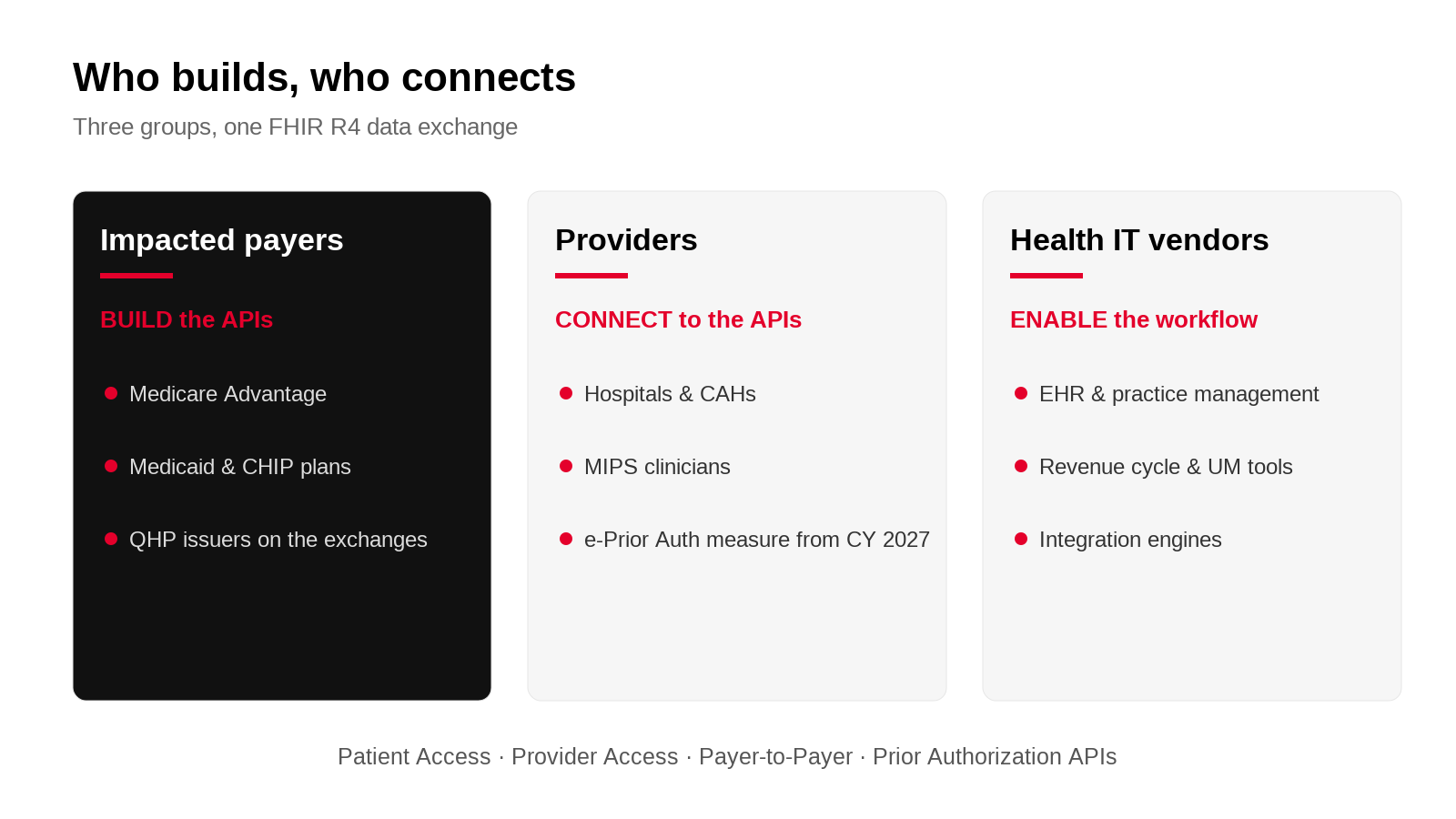
The rule applies to "impacted payers":
- Medicare Advantage organisations
- State Medicaid and CHIP fee-for-service programmes
- Medicaid managed care plans and CHIP managed care entities
- Qualified Health Plan (QHP) issuers on the Federally-facilitated Exchanges
Commercial employer plans are not directly covered, although some may adopt the same APIs. Hospitals and clinicians are not named as covered parties either, but they are affected through a new electronic prior authorisation measure (see below).
What is already in force
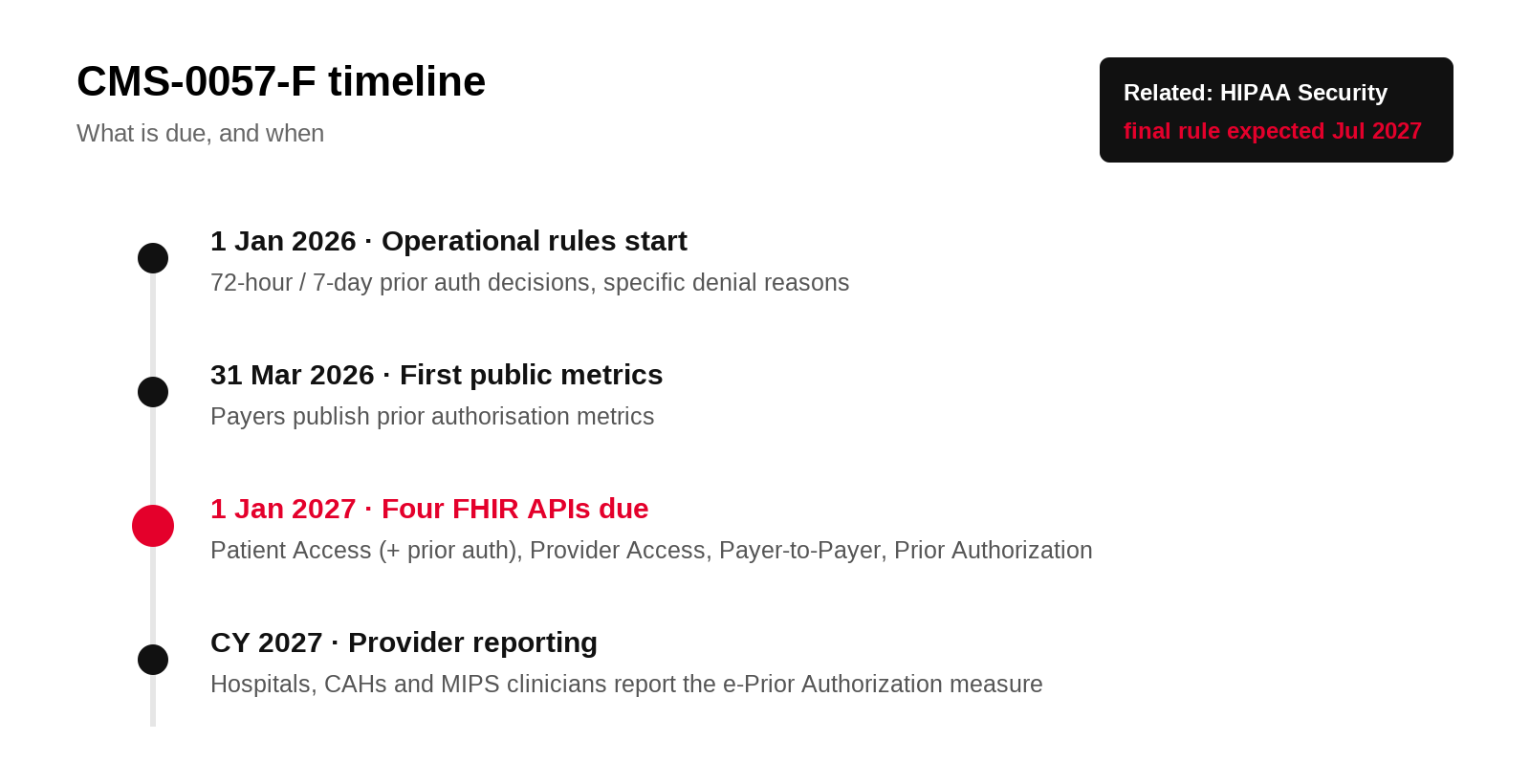
Some operational requirements began on 1 January 2026. Impacted payers must decide prior authorisation requests within 72 hours for expedited requests and seven calendar days for standard requests (QHP issuers on the exchanges are excluded from these timeframes), give a specific reason when they deny a request, and publish prior authorisation metrics. The first metrics were due by 31 March 2026.
The four APIs due by 1 January 2027
- Patient Access API: this API already exists; it must now also include prior authorisation information (excluding drugs), so patients can see the status of their requests.
- Provider Access API: lets in-network providers retrieve claims, encounter and clinical data for their attributed patients.
- Payer-to-Payer API: moves a member's data to their new plan when they switch, with the member's permission.
- Prior Authorization API: lets a provider's system check whether prior authorisation is needed and what documentation is required, then submit the request electronically.
All four are built on HL7 FHIR R4. CMS recommends specific implementation guides (including CARIN, PDex and the Da Vinci prior authorisation guides) rather than mandating them, but most payers are expected to follow them.
What it means for providers
Eligible hospitals and critical access hospitals start reporting a new "Electronic Prior Authorization" measure from the CY 2027 EHR reporting period, and MIPS clinicians from the CY 2027 performance period. To use the payers' new APIs, providers need their EHR, practice management or revenue cycle systems to connect to them, typically through vendor upgrades, an integration engine or a clearinghouse.
Providers should also keep information blocking in mind. In February 2026 the federal health IT regulator (ASTP/ONC) began issuing non-conformity letters to certified EHR developers, and providers found to be information blocking face Medicare payment disincentives.
What it means for health IT vendors
EHR, revenue cycle, utilisation management and digital health vendors will be expected to connect to payer FHIR APIs and support electronic prior authorisation workflows. Smaller vendors often lack FHIR specialists, which is where a focused integration partner helps.
A practical readiness checklist
- Confirm your role: impacted payer, provider that will use the APIs, or vendor that must connect to them.
- Inventory data sources: claims, encounters, clinical data and prior authorisation records.
- Map data to FHIR R4 resources and the relevant implementation guides; data quality problems usually surface here.
- Choose a build approach: FHIR server, integration engine or managed FHIR platform.
- Plan identity, consent and security: OAuth 2.0 and SMART on FHIR, member matching and audit logging.
- Test with real partners early; sandbox and connectathon testing saves months.
- Set up production monitoring and support, including uptime and response-time reporting.
Related deadline: HIPAA security
HHS has proposed the first major update to the HIPAA Security Rule in more than a decade, including multi-factor authentication, encryption and network segmentation. The final rule is now expected around July 2027. New APIs widen your attack surface, so security work should run in parallel.
How TecZodus Global can help
TecZodus Global supports health plans, providers and health IT vendors with FHIR and HL7 integration, data mapping and migration, API testing and ongoing managed support. Talk to us about a readiness review, or see our services for US healthcare organisations.
Sources
Talk to an expert
More insights
- Healthcare Data Migration: How to Move Without Losing Records
A vendor-neutral guide to migrating EMR and imaging data: planning, mapping, patient and study reconciliation, validation, cut-over and legacy archiving. - PDPL & Healthcare Cybersecurity: A Saudi Provider Checklist
What Saudi Arabia's PDPL and the NCA's Essential Cybersecurity Controls mean for health data, with practical controls and a ten-point checklist for providers. - FHIR Explained for Hospital IT Leaders
What HL7 FHIR is, how it differs from HL7 v2 and DICOM, where national programmes use it, and a practical roadmap for hospitals adopting it.