FHIR Explained for Hospital IT Leaders
FHIR has moved from a standards-committee topic to a procurement requirement. National programmes, insurers and software vendors increasingly expect hospitals to exchange data through FHIR APIs, yet many IT teams still run their integration estate on HL7 v2 interfaces and DICOM. This guide explains what FHIR is, how it fits alongside the standards you already run, and how to adopt it without disrupting operations.
What HL7 FHIR actually is
FHIR (Fast Healthcare Interoperability Resources) is a standards framework published by HL7 International. According to the official specification, it combines the best features of HL7 v2, HL7 v3 and CDA while building on current web standards such as REST, JSON and XML. The current published version is R5, but most national programmes and production systems are built on R4 (version 4.0.1), the release that introduced normative content and therefore long-term stability.
Three ideas define FHIR:
- Resources: small, modular building blocks such as Patient, Encounter, Observation, DiagnosticReport, ImagingStudy, Coverage and Claim. Each has a defined structure and a human-readable narrative.
- APIs: resources are read, created, updated and searched over standard HTTP, so any developer familiar with web APIs can work with them.
- Profiles and implementation guides: base resources are deliberately generic. Countries and programmes constrain them with profiles, extensions and terminology bindings, published as implementation guides (IGs).
The specification also supports four exchange paradigms: RESTful APIs, messaging, documents and services. This matters, because a national programme may use FHIR messaging rather than pure REST, and your integration design must follow the IG, not assumptions.
How FHIR differs from HL7 v2 and DICOM
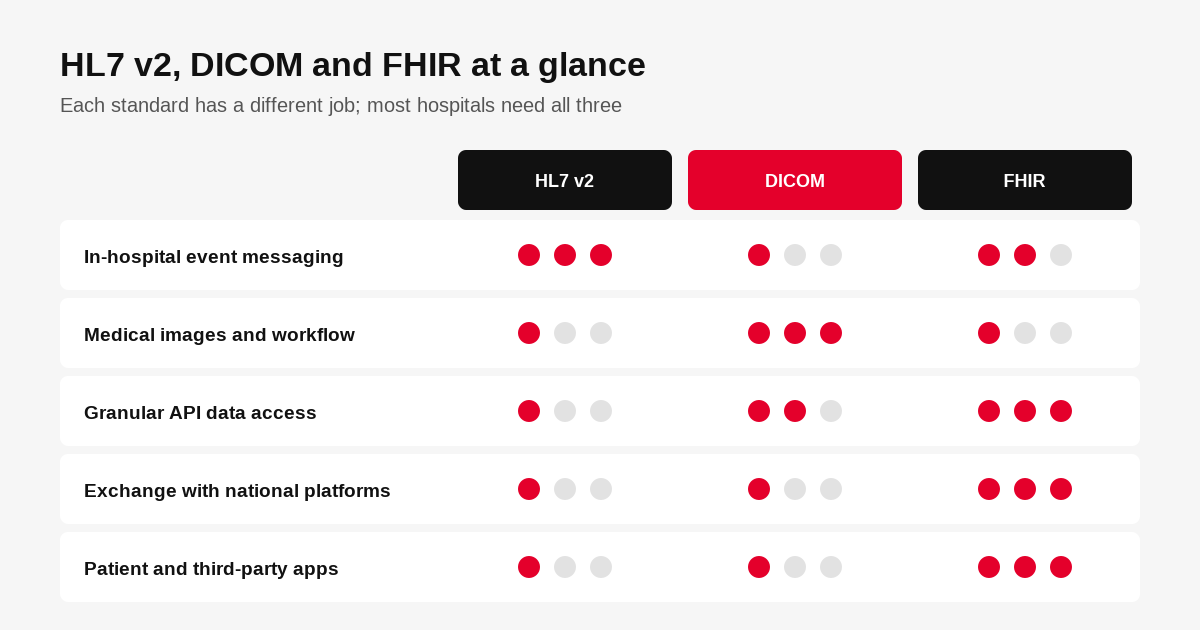
FHIR does not replace everything you run today. Each standard has a distinct job.
- HL7 v2 is the workhorse of in-hospital integration: ADT, orders and results flowing through an interface engine as pipe-delimited messages. It is event-driven, highly customised per site and rarely exposed outside the firewall.
- DICOM governs medical images and imaging workflow: image objects, modality worklists, storage and retrieval, plus DICOMweb for web-based access. FHIR does not carry pixel data.
- FHIR is designed for granular, queryable access to clinical and administrative data, and for exchange between organisations, apps and national platforms.
In practice, a modern hospital runs all three. A radiology order may arrive as HL7 v2, images are stored and moved as DICOM, and the finalised report and study reference are exposed to a national record or patient app as FHIR DiagnosticReport and ImagingStudy resources.
Where FHIR is used today
FHIR is now the default choice for national health data exchange. Two examples are directly relevant to our regions:
- Saudi Arabia, NPHIES: the national platform for health insurance transactions, launched by the Council of Health Insurance and the National Health Information Center in cooperation with the Ministry of Health. Its Healthcare Financial Services implementation guide, published by HL7 Saudi Arabia, is based on FHIR 4.0.1 and covers eligibility, prior authorisation, claims and payment reconciliation using FHIR messaging.
- India, ABDM: the Ayushman Bharat Digital Mission publishes a FHIR R4 implementation guide through NRCeS, defining profiles for health records such as diagnostic reports, discharge summaries, prescriptions, OP consultation notes and immunisation records. The same guide supports the National Health Claims Exchange (NHCX).
Beyond national programmes, FHIR is widely used for patient-facing apps, clinical decision support, AI model integration, population health analytics and research data pipelines.
A practical adoption roadmap
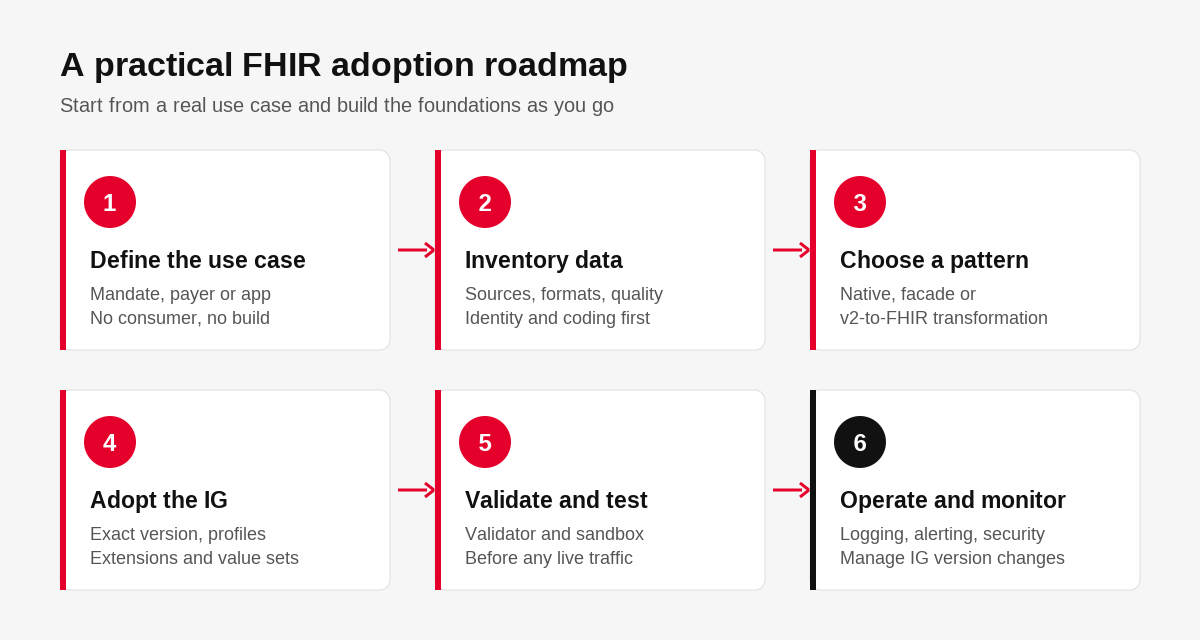
FHIR adoption works best as a programme, not a single interface project.
- Start with a mandate or use case: a regulatory requirement (NPHIES, ABDM), a payer connection or a patient app. Avoid building a generic FHIR layer with no consumer.
- Inventory your data sources: which systems hold the data the use case needs, in what format, and how clean it is. Master patient identifiers, coding and practitioner data are usually the hardest parts.
- Choose the integration pattern: native FHIR support in source systems, a FHIR facade over existing databases, or transformation from HL7 v2 in your interface engine. Many hospitals use a mix.
- Adopt the right implementation guide: build against the exact IG version required, including its profiles, extensions and code systems.
- Map terminology early: local codes must be mapped to the value sets the IG requires. This is where most of the effort goes.
- Test against the validator and sandbox: validate every resource against the published profiles before connecting to a live environment.
- Operate and monitor: treat FHIR endpoints as production services with logging, alerting, version management and security reviews.
Common pitfalls to avoid
- Assuming "FHIR-enabled" means compliant: a system can support base FHIR resources and still fail a national profile. Ask vendors which IG and version they conform to.
- Ignoring terminology: valid JSON with the wrong codes is still rejected or, worse, misinterpreted.
- Underestimating identity: duplicate patients and inconsistent practitioner or facility identifiers break downstream exchange.
- Treating FHIR as a replacement for v2 or DICOM: rip-and-replace rarely pays off. Use FHIR where it adds value.
- Neglecting security and consent: APIs expose data beyond the firewall. Authentication, authorisation, audit and consent management must be designed in, not added later.
- Version drift: national IGs are updated. Without a change process, interfaces that passed testing will start failing.
Conclusion
FHIR is less about a new message format and more about a new way of exposing healthcare data: modular, web-based and governed by implementation guides. Hospitals that treat it as a strategic capability, grounded in clean master data, terminology mapping and disciplined testing, will find national programme mandates, payer integrations and AI projects far easier to deliver.
Planning a FHIR integration or interoperability project? Talk to our team at info@teczodus.com.
Sources
Talk to an expert
More insights
- India's ABDM Explained for Hospitals and Imaging Centres
ABHA, HPR, HFR, consent-based exchange, FHIR and incentives: what India's Ayushman Bharat Digital Mission means for hospitals, labs and imaging centres. - Going Digital in Pathology: What Labs Need First
Before buying scanners or AI, labs need the right foundations: storage, network, LIS integration, DICOM and validation. Here is what comes first. - Healthcare Data Migration: How to Move Without Losing Records
A vendor-neutral guide to migrating EMR and imaging data: planning, mapping, patient and study reconciliation, validation, cut-over and legacy archiving.