PDPL & Healthcare Cybersecurity: A Saudi Provider Checklist
Saudi healthcare providers now operate under two overlapping expectations: protect patient privacy under the Personal Data Protection Law (PDPL), and run a security programme that would stand up to scrutiny against the National Cybersecurity Authority's controls. For a hospital or imaging centre, these are not separate projects. The same access rights, logs, backups and vendor connections decide whether you can show compliance and whether a breach becomes a crisis.
This guide summarises what the rules say about health data and turns them into a practical checklist. It is a general overview, not legal advice; confirm your specific obligations with qualified counsel.
Where the PDPL stands today
The PDPL was issued by Royal Decree No. M/19 and, after amendment, came into force on 14 September 2023. Organisations were given a one-year grace period, and the law became fully enforceable on 14 September 2024. Its Implementing Regulation and a separate regulation on transfers outside the Kingdom set out the operational detail.
The Saudi Data and Artificial Intelligence Authority (SDAIA) is the competent authority. It oversees enforcement, handles complaints, publishes guidance and runs the National Data Governance Platform, where controllers register and where breach notifications are made.
Penalties are significant. Administrative fines can reach SAR 5 million and may be doubled for repeat violations, and unlawful disclosure of sensitive data can, in certain circumstances, carry imprisonment of up to two years.
Keep an eye on what comes next. In October 2026 SDAIA opened a public consultation on amendments to the Implementing Regulation, including proposals on storing personal data inside the Kingdom and on wider triggers for data protection impact assessments, such as processing sensitive data. These were proposals at the time of writing, so track the final text before you change architecture.
What the PDPL means for health data
Health data is explicitly treated as sensitive data, which raises the bar across the board. In practice, that means:
- Need-to-know access. Access to health data should be restricted to the staff whose role genuinely requires it, with access levels reflecting role and responsibility, and reviewed regularly.
- Documented processing. Controllers are expected to document how health data is processed across its lifecycle and to keep a current picture of where data sits and how it flows.
- Registration. Controllers processing sensitive data are expected to register on the National Data Governance Platform.
- Minimisation and purpose. Collect and keep only what is needed to deliver care, and do not use sensitive data for direct marketing.
- Sector rules still apply. Requirements from health sector bodies sit alongside the PDPL, not instead of it.
Breach notification and cross-border transfers
Breach notification. Where a personal data breach may cause harm to the data or to individuals' rights and interests, the controller must notify SDAIA within 72 hours of becoming aware of it. Affected individuals must be told without undue delay where the breach could harm them, and processors must inform the controller promptly. Seventy-two hours is short when a ransomware incident has taken out the PACS and the EMR at once, so the decision-making path, contact list and evidence templates need to exist before the incident, not during it.
Cross-border transfers. SDAIA issued an amended regulation on transferring personal data outside the Kingdom in September 2024, together with standard contractual clauses. Transfers are possible but must not conflict with national interests. Where a destination is not covered by an adequacy decision, controllers rely on appropriate safeguards: SDAIA's standard contractual clauses, binding common rules within a group, or a certificate of accreditation. A risk assessment is required when relying on those safeguards and when sensitive data is transferred continuously or at large scale.
For healthcare, the transfers to look for are rarely obvious. They include cloud backups, teleradiology reads, AI processing, vendor support portals and offshore help desks. Each one needs a documented basis.
Why the NCA Essential Cybersecurity Controls matter
The NCA's Essential Cybersecurity Controls (ECC-2:2024) are organised into four main domains: governance, defence, resilience, and third-party and cloud computing cybersecurity, spanning 28 subdomains and 108 main controls. They are mandatory for government entities and for private organisations that own, operate or host critical national infrastructure, and others are encouraged to adopt them.
Even where ECC is not mandatory for you, it is the most useful local yardstick for the "appropriate technical and organisational measures" the PDPL expects. A few controls map directly to healthcare pain points:
- Multi-factor authentication for remote access and privileged accounts.
- Event logs retained for at least 12 months.
- Backups that cover critical systems, enable quick recovery and are tested periodically.
- Third-party contracts covering confidentiality, secure data removal at service end and incident communication.
- Managed service operations that use remote access fully located in the Kingdom.
Practical controls for hospitals and imaging centres
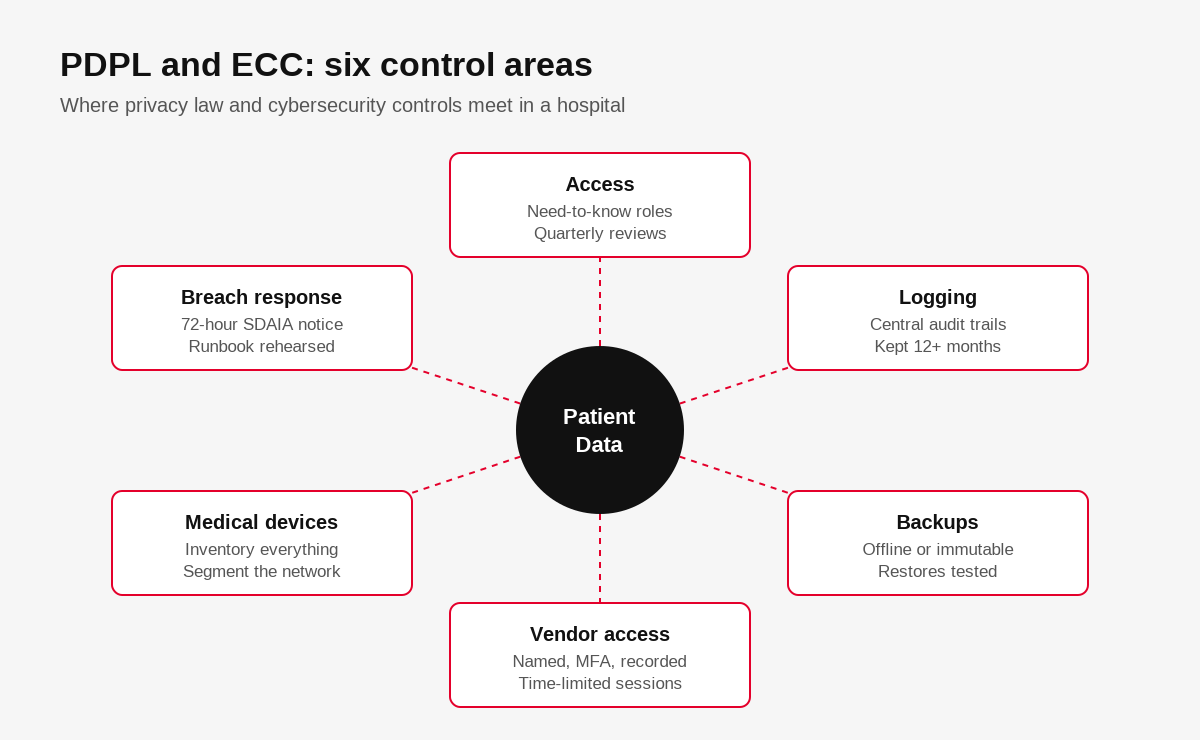
Access. Build role-based access on the clinical system of record, remove generic and shared logins, and run quarterly access reviews with department heads. Pay attention to break-glass accounts and to radiologists or clinicians reading from home.
Logging. Centralise audit trails from EMR, PACS, RIS, lab and identity systems, and keep them long enough to investigate. Logs that only the vendor can read are not much help in a 72-hour window.
Backups. Keep at least one copy offline or immutable, test full restores of clinical systems, and know how long recovering the imaging archive would really take.
Vendor remote access. Replace always-on VPNs and shared vendor accounts with named, time-limited, approved and recorded sessions. Review where support teams actually sit.
Medical devices. Inventory modalities, analysers and other connected devices, segment them from the corporate network, and track unsupported operating systems that cannot be patched.
Your PDPL and cybersecurity checklist
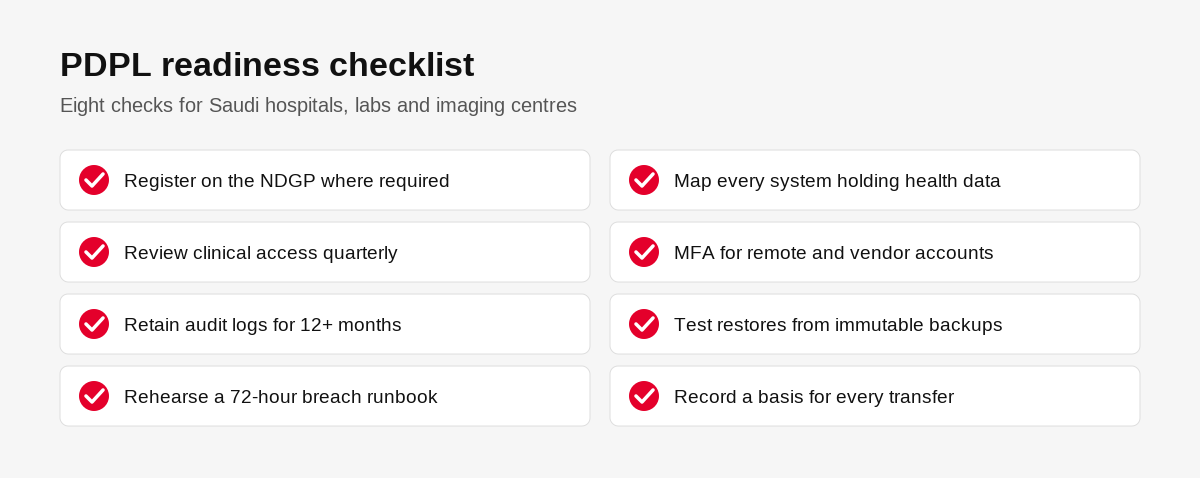
- Register as a controller on the National Data Governance Platform where required.
- Maintain a data map of every system holding health data, including vendor-hosted ones.
- Review and minimise access to clinical systems at least quarterly.
- Enforce multi-factor authentication for remote, privileged and vendor accounts.
- Centralise audit logs and retain them for at least 12 months.
- Test restores of EMR and imaging data from offline or immutable backups.
- Document a 72-hour breach notification runbook and rehearse it.
- List every cross-border transfer and record its legal basis and risk assessment.
- Add confidentiality, data return and incident clauses to vendor contracts.
- Segment and inventory medical devices, and track those that cannot be patched.
Conclusion
The PDPL and ECC ask for the same thing in different words: know where patient data is, limit who can touch it, prove what happened, and recover quickly. Providers that treat privacy and security as one programme will find both audits and incidents far easier to handle. Start with the data map and vendor access, as they usually reveal the biggest gaps.
Planning a PDPL or healthcare cybersecurity project? Talk to our team at info@teczodus.com.
Sources
- SDAIA: Personal Data Protection Law (English text)
- National Cybersecurity Authority: Essential Cybersecurity Controls (ECC-2:2024)
- CMS: One year anniversary – Saudi Personal Data Protection Law
- Mayer Brown: Updates to Saudi Arabia's Personal Data Protection Regulations – SCCs, guidelines and more
- Bird & Bird: Saudi Arabia – Health data under the Personal Data Protection Law
- Al Tamimi & Company: SDAIA opens public consultation on proposed amendments to the PDPL Implementing Regulation
Talk to an expert
More insights
- India's ABDM Explained for Hospitals and Imaging Centres
ABHA, HPR, HFR, consent-based exchange, FHIR and incentives: what India's Ayushman Bharat Digital Mission means for hospitals, labs and imaging centres. - Going Digital in Pathology: What Labs Need First
Before buying scanners or AI, labs need the right foundations: storage, network, LIS integration, DICOM and validation. Here is what comes first. - Healthcare Data Migration: How to Move Without Losing Records
A vendor-neutral guide to migrating EMR and imaging data: planning, mapping, patient and study reconciliation, validation, cut-over and legacy archiving.