How to Evaluate a Radiology AI Tool Before You Buy
Radiology has become the busiest proving ground for clinical AI. Regulators now list hundreds of authorised imaging algorithms, and vendors approach hospitals and imaging centres every week with triage, detection, quantification and workflow tools. The hard question for leaders is no longer whether AI can help, but whether a specific tool will deliver safe, measurable value in your department, with your scanners, your patients and your reporting workflow.
This guide sets out a practical, vendor-neutral way to evaluate a radiology AI tool before you sign a contract. Every evaluation should begin with a clearly defined use case. Which bottleneck or risk are you trying to address: turnaround time for urgent findings, missed incidental findings, reporting backlogs, or time spent on repetitive measurements? Who will use the output, and what will they do differently because of it?
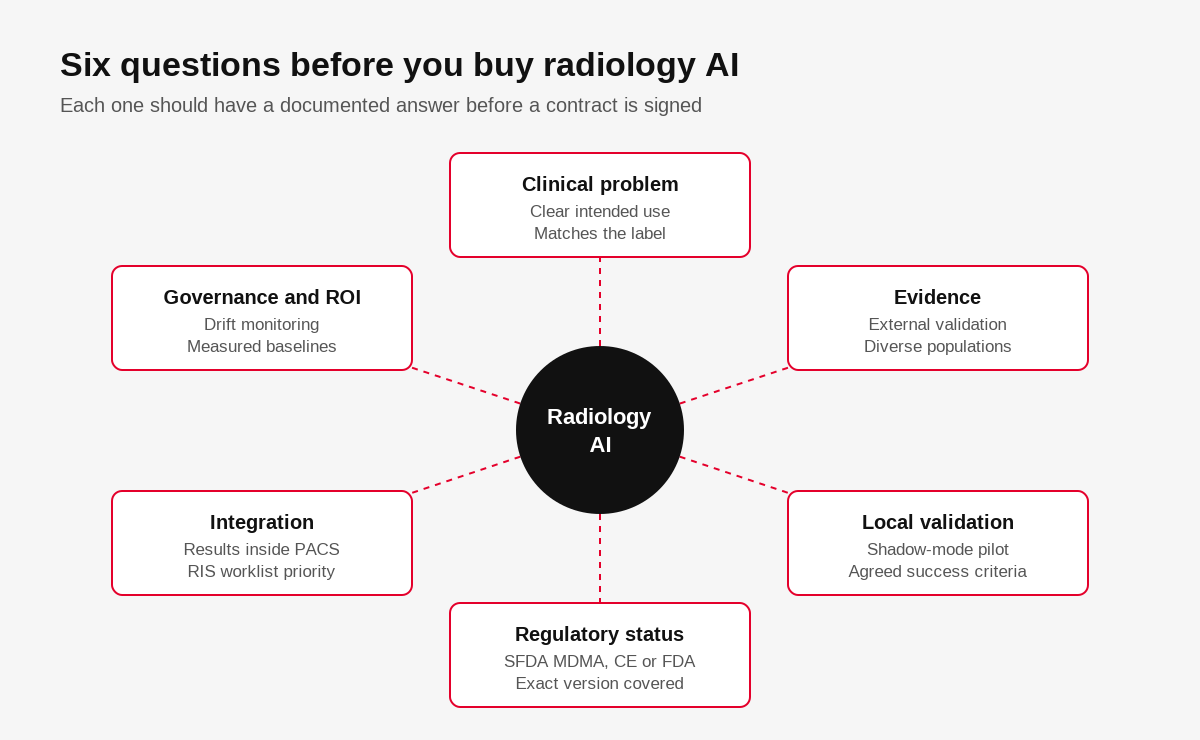
Write the intended use down in one or two sentences and compare it, word for word, with the intended use in the product's regulatory documentation. A tool cleared to flag suspected findings for worklist prioritisation is not the same as one authorised to support diagnosis, and using it outside its labelled purpose shifts risk to your organisation.
Clinical validation and local validation
Published accuracy figures are a starting point, not proof that a tool will work for you. Ask the vendor for the evidence behind its claims and look closely at how it was generated.
- Study design: was performance measured retrospectively on curated datasets, or prospectively in live clinical workflow?
- Data diversity: which countries, sites, scanner manufacturers, protocols and patient populations were represented?
- Reference standard: how was ground truth established, and by whom?
- Metrics that matter: sensitivity and specificity at the operating threshold you will actually use, plus false-positive rates per study, not just a headline area-under-the-curve figure.
- Subgroup performance: results by age, sex, body habitus and disease prevalence where relevant.
Then run your own local validation. A silent or shadow-mode pilot, where the AI processes real studies without influencing reports, lets you compare its output with your radiologists' findings on your own case mix and equipment. Agree the success criteria, sample size and review process before the pilot starts, so that the go or no-go decision is objective.
Regulatory status: check the exact authorisation
Treat regulatory status as a gate, not a tie-breaker. In Saudi Arabia, AI software with a medical purpose is generally regulated as Software as a Medical Device and needs a Medical Device Marketing Authorization (MDMA) from the Saudi Food and Drug Authority (SFDA). The SFDA has published dedicated guidance for AI and machine learning-enabled medical devices (MDS-G010), and its digital health guidance (MDS-G027) expects testing on diverse, high-quality datasets, transparency about limitations and bias, defined human oversight, and documented change management with post-market performance monitoring.
In Europe, AI medical devices need CE marking under the Medical Device Regulation, and most AI devices that require notified-body review will also be classed as high-risk systems under the EU AI Act as its obligations phase in. In the United States, the FDA maintains a public list of AI-enabled devices it has authorised, and radiology accounts for the large majority of entries. The FDA has also issued final guidance on Predetermined Change Control Plans, which allow manufacturers to pre-specify how an algorithm may be updated after authorisation.
Ask for the certificate or listing itself, confirm that the version, indication and modality you are buying are covered, and check whether authorisation in one market is being presented as if it applies in another.
Workflow and PACS/RIS integration
Even an accurate algorithm fails if radiologists have to leave their reading environment to see its results. Integration is where many pilots stall, so examine it in detail.
- How are studies routed to the AI: DICOM forwarding from modalities or PACS, or a vendor-neutral orchestration layer?
- How are results returned: DICOM secondary capture, DICOM Structured Report, presentation states or an HL7 or FHIR message to the RIS?
- Do results appear inside the existing viewer and worklist, and can the RIS reprioritise studies based on AI flags?
- Is processing on-premises, in a private cloud or in the vendor's cloud, and where exactly is patient data stored and processed?
- What happens when the AI service is slow or unavailable? Reading must continue without delay.
Involve your PACS administrator, integration team and information security lead early. Data residency and cybersecurity reviews can take longer than the clinical evaluation, particularly where images would leave the country.
Governance, monitoring and model drift
AI performance is not fixed. Changes in scanners, protocols, software versions or patient populations can degrade accuracy over time, a problem known as drift. Before go-live, agree who owns the tool clinically and technically, and how its performance will be tracked.
A simple governance model includes an AI oversight group with radiology, IT, quality and information governance members; a register of deployed algorithms and versions; a process for radiologists to flag disagreements; periodic audits against a sample of reports; and a clear rule for when a model is paused or rolled back. Ask vendors how they notify customers of updates and whether updates require revalidation on site.
Building a realistic ROI case
Return on investment in radiology AI rarely comes from headcount reduction. More credible value drivers include faster turnaround for critical findings, fewer missed findings and recalls, shorter length of stay where imaging is on the critical path, reduced overtime or outsourcing, and better use of scarce subspecialist time.
Build your model on baseline data you can measure today, such as report turnaround times, backlog volumes and discrepancy rates, and include the full cost: licences, per-study fees, integration, infrastructure, validation effort, training and ongoing monitoring. Pricing models vary widely, so compare total cost over the contract term rather than headline licence fees.
A buyer's checklist
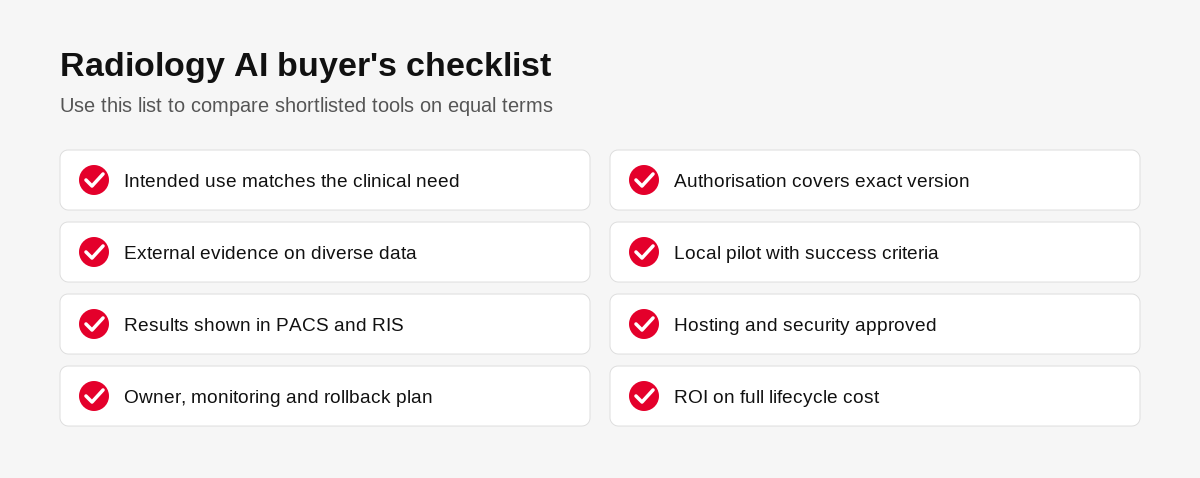
- Intended use is documented and matches your clinical problem.
- Valid MDMA, CE or FDA authorisation covers the exact version, modality and indication.
- Evidence includes external validation on diverse populations and equipment.
- A local shadow-mode pilot has defined success criteria.
- Results appear inside your existing PACS, viewer and RIS worklist.
- Data flows, hosting location and cybersecurity controls are approved.
- A named clinical owner, monitoring plan and rollback rule are in place.
- The ROI model uses measured baselines and full lifecycle costs.
- The contract covers updates, performance reporting, data ownership and exit terms.
Conclusion
Radiology AI can genuinely ease workload and improve patient care, but only when it is chosen against a clear problem, validated locally, integrated into the reading workflow and governed over its whole lifecycle. A structured evaluation protects patients, radiologists and budgets, and it gives vendors a fair, transparent route to proving their value.
Planning a radiology AI evaluation or integration project? Talk to our team at info@teczodus.com.
Sources
- SFDA: Guidance for Artificial Intelligence and Machine Learning (AI/ML)-Enabled Medical Devices (MDS-G010)
- SFDA: Guidance on Digital Health Products (MDS-G027)
- U.S. FDA: Artificial Intelligence-Enabled Medical Devices
- Ropes & Gray: FDA Finalizes Guidance on Predetermined Change Control Plans for AI-Enabled Devices
- OpenRegulatory: MDCG 2025-6 – MDR/IVDR and the AI Act interplay explained
Talk to an expert
More insights
- India's ABDM Explained for Hospitals and Imaging Centres
ABHA, HPR, HFR, consent-based exchange, FHIR and incentives: what India's Ayushman Bharat Digital Mission means for hospitals, labs and imaging centres. - Going Digital in Pathology: What Labs Need First
Before buying scanners or AI, labs need the right foundations: storage, network, LIS integration, DICOM and validation. Here is what comes first. - Healthcare Data Migration: How to Move Without Losing Records
A vendor-neutral guide to migrating EMR and imaging data: planning, mapping, patient and study reconciliation, validation, cut-over and legacy archiving.