India's ABDM Explained for Hospitals and Imaging Centres
India is building one of the largest national digital health ecosystems in the world. The Ayushman Bharat Digital Mission (ABDM), launched by the Government of India in September 2021 and implemented by the National Health Authority (NHA), aims to connect patients, professionals, facilities and software through shared digital building blocks.
By mid-2026 the government reported more than 93 crore ABHA accounts and over 104 crore health records linked to them. For hospitals, diagnostic laboratories and imaging centres, ABDM is no longer a pilot to watch. It is becoming part of how patients expect to receive and share their reports, and part of how software is bought and certified.
This guide explains the components, the standards behind them and what providers and their technology vendors need to do.
The building blocks of ABDM
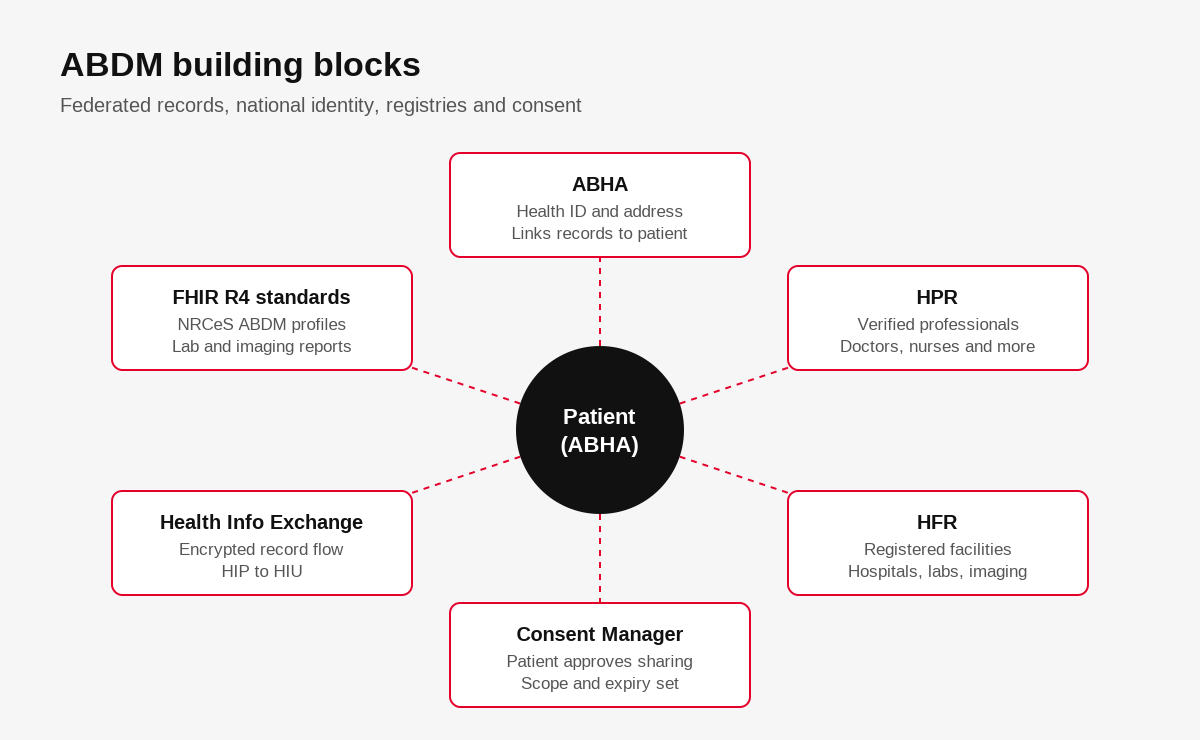
ABDM is federated by design. Records stay with the facility that created them; the national layer provides identity, registries and a consent-based exchange.
- ABHA (Ayushman Bharat Health Account): a health ID for citizens, with an address the patient can use to link records from different providers and share them on request.
- HPR (Healthcare Professionals Registry): a verified registry of doctors, nurses and other professionals across systems of medicine.
- HFR (Health Facility Registry): a registry of public and private facilities, including hospitals, clinics, laboratories, imaging centres and pharmacies. Government figures reported in August 2025 showed more than 4.18 lakh facilities in HFR and more than 6.79 lakh professionals in HPR.
- Health Information Exchange and Consent Manager: the switch that lets a patient approve, through a personal health record app, who may see which records and for how long.
In ABDM terms, a facility that holds and shares records is a Health Information Provider (HIP) and one that requests records, with consent, is a Health Information User (HIU). Most hospitals will be both.
How consent-based exchange works
The patient is at the centre. A hospital links an encounter, lab result or imaging report to the patient's ABHA. Later, another provider requests access. The patient receives the request in their app, approves or declines it and can set the date range and expiry. Only then does the original facility send the data, encrypted, through the exchange.
This model matters for diagnostics. Instead of patients carrying printed reports and CDs between centres, a referring clinician can request a prior report directly, with an auditable consent trail. ABDM's Scan and Share service also lets patients share their ABHA details at registration by scanning a QR code; the government reported more than 23 crore ABHA-linked tokens issued by June 2026.
FHIR: the language of ABDM records
ABDM records are exchanged using HL7 FHIR R4. The National Resource Centre for EHR Standards (NRCeS) publishes the FHIR Implementation Guide for ABDM, which defines profiles for record types such as prescriptions, discharge summaries, OP consultation notes and diagnostic reports, including separate profiles for laboratory and imaging reports.
For imaging centres the practical implication is clear. The radiology report must be available as a structured FHIR diagnostic report bundle, with correct patient, facility and practitioner references. Images themselves continue to live in your PACS under DICOM; ABDM carries the report and references to studies, not the full image data. Vendors should check which version of the implementation guide their certification targets, since profiles are revised over time.
Incentives: the Digital Health Incentive Scheme
To encourage adoption, the NHA launched the Digital Health Incentive Scheme (DHIS) on 1 January 2023. It rewards registered hospitals, diagnostic laboratories and digital solution companies for digital transactions that link health records to ABHA, paying per additional record above a threshold. The scheme has been extended since its launch, and according to a July 2026 government backgrounder, incentives paid as of June 2026 exceeded Rs 107 crore to hospitals, Rs 2.95 crore to diagnostics, laboratories and pharmacies, and Rs 26 crore to digital solution companies.
Rates, thresholds and validity periods have changed over the life of the scheme, so confirm the current terms on the official ABDM website before building a business case around them.
What providers and software vendors need to do
Compliance is shared between the facility and its software. Each has distinct responsibilities.
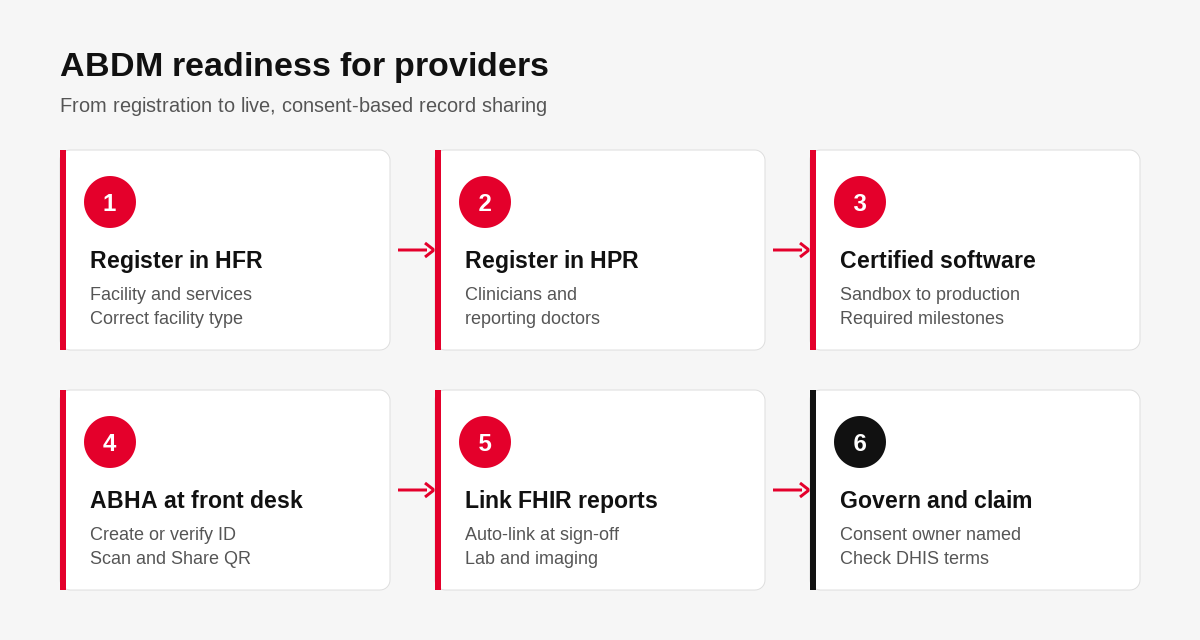
- Providers: register the facility in HFR and clinicians in HPR; train front desks to create or verify ABHA at registration; enable Scan and Share; define who approves consent requests and how records are linked.
- Software vendors (HIS, LIS, RIS, PACS reporting modules): integrate with the ABDM sandbox, implement ABHA creation and verification, HIP and HIU flows and FHIR bundles, then complete NHA's functional testing to move to production. Integration is organised into milestones covering ABHA, sharing records and requesting records.
- Both: align privacy and security controls with the consent model and India's data protection law, and keep an audit trail of every share.
ABDM readiness checklist
- Facility registered in HFR, with correct facility type and services listed.
- Radiologists, pathologists and clinicians registered in HPR.
- ABHA creation or verification at every registration counter.
- Scan and Share QR codes displayed and front-desk staff trained.
- Software confirmed as ABDM-certified for the milestones you need, not just "ABDM-ready".
- Laboratory and imaging reports generated as valid FHIR bundles to the current NRCeS profiles.
- Report linking automated at sign-off, not left to manual uploads.
- A named owner for consent requests, incentive claims and ABDM dashboards.
- Privacy notices and consent processes reviewed against current data protection rules.
Conclusion
ABDM gives Indian healthcare a common identity, common registries and a common language for records. For hospitals and imaging centres, the early wins are practical: faster registration, fewer lost reports and easier referrals. For software vendors, certification is fast becoming a basic requirement in procurement. The organisations that treat ABDM as a workflow change, not just an API project, will capture the most value.
Planning an ABDM integration project? Talk to our team at info@teczodus.com.
Sources
- Ayushman Bharat Digital Mission: Official website
- Press Information Bureau: Ayushman Bharat Digital Mission, India's Digital Health Backbone (July 2026)
- DD News: Over 79.9 crore Ayushman Bharat Health Accounts created, Centre (August 2025)
- NRCeS: FHIR Implementation Guide for ABDM, profiles
- NRCeS: DiagnosticReportLab profile
- ABDM Developer Forum: M1 and M2 certification features
Talk to an expert
More insights
- Going Digital in Pathology: What Labs Need First
Before buying scanners or AI, labs need the right foundations: storage, network, LIS integration, DICOM and validation. Here is what comes first. - Healthcare Data Migration: How to Move Without Losing Records
A vendor-neutral guide to migrating EMR and imaging data: planning, mapping, patient and study reconciliation, validation, cut-over and legacy archiving. - Teleradiology in the Gulf: Operating Models and What to Check
Hub-and-spoke, outsourced, hybrid or cross-border? How Gulf providers can choose a teleradiology model and handle licensing, data residency, technology and SLAs.