Teleradiology in the Gulf: Operating Models and What to Check

Imaging volumes across the Gulf continue to rise as populations grow, hospital networks expand and screening and emergency services mature. Recruiting enough radiologists, and especially subspecialists, to report every study on site and around the clock is difficult for many organisations. Teleradiology, the remote reporting of images by qualified radiologists, has become a core part of how hospitals and imaging centres in the region manage demand.
This article outlines the main operating models, the regulatory and data considerations specific to Saudi Arabia and the wider GCC, and the questions to ask before you commit.
Why demand for teleradiology is growing
Several pressures push organisations towards remote reporting. Out-of-hours emergency imaging needs fast, reliable reports at night and at weekends. Smaller hospitals and outpatient centres may not justify a full-time subspecialist in neuroradiology, musculoskeletal or paediatric imaging, yet their patients still need that expertise. New facilities often open before their local reporting teams are fully recruited, and backlogs build quickly when demand outpaces capacity.
National strategy also plays a role. Saudi Arabia's health transformation has put strong emphasis on virtual care, illustrated by the launch of the SEHA Virtual Hospital, which connects hospitals across the Kingdom to remote specialist services. That shift makes remote clinical services, including imaging, a normal part of care delivery rather than an exception.
Four operating models
There is no single right model. Most organisations end up with a mix, and the right choice depends on volumes, subspecialty needs, budgets and regulatory constraints.
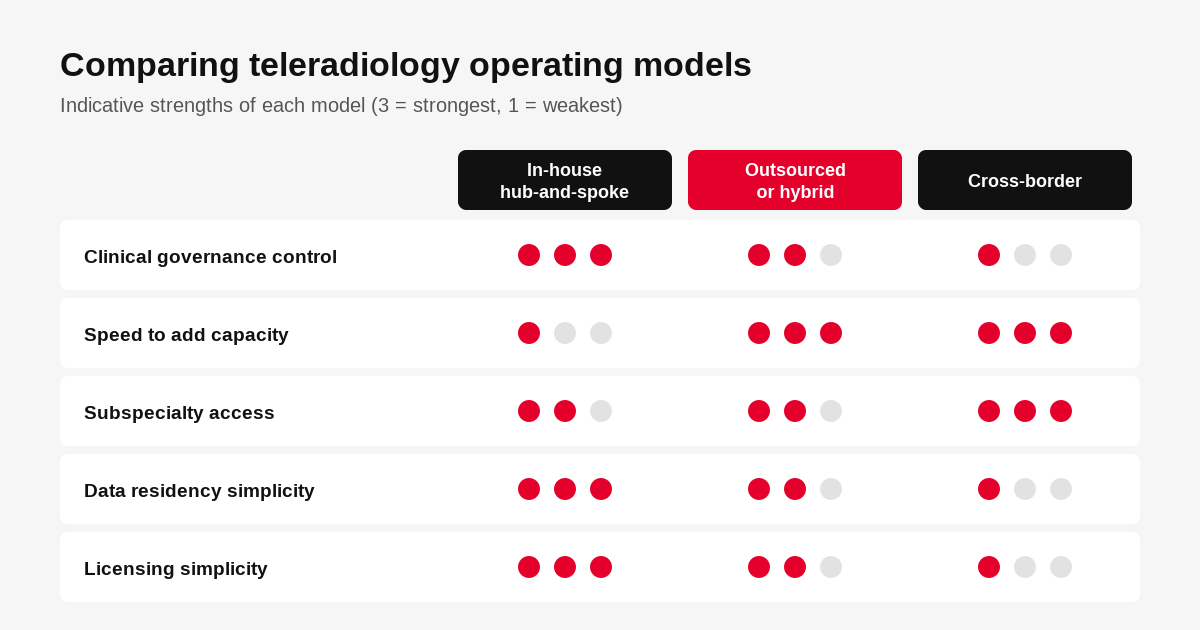
- In-house hub-and-spoke: a central hub, often a tertiary hospital or group reading centre, reports studies from smaller spoke sites in the same network. This keeps reporting under one clinical governance framework and data inside the organisation, but requires investment in the hub's staffing and infrastructure.
- Outsourced to a domestic provider: a licensed teleradiology company reports some or all studies under a service agreement. This adds capacity quickly and converts fixed costs to variable ones, but requires strong contract management and quality oversight.
- Hybrid: in-house radiologists report during the day and most routine work, while an external partner covers nights, overflow or specific subspecialties. This is common because it balances control and flexibility.
- Cross-border: radiologists in another country, often in a different time zone, report studies remotely. This can provide daytime reading for overnight studies and access to scarce subspecialists, but it raises the most complex licensing and data transfer questions.
Licensing, credentialing and accountability
Whatever the model, the radiologist who signs the report must be legally entitled to do so for patients in that country. In Saudi Arabia, health practitioners are classified and registered by the Saudi Commission for Health Specialties (SCFHS), and the Ministry of Health has issued regulations for telehealth services that require providers to be licensed, require practitioners to be credentialed and privileged, and require written agreements setting out each party's responsibilities when more than one entity is involved, including partners outside the Kingdom. Licensing rules are updated from time to time, so confirm the current requirements with the regulator before contracting.
Similar principles apply across the GCC, where each country and in some cases each emirate has its own health authority and licensing process. As a minimum, the reporting radiologist should hold a valid licence recognised by the regulator where the patient is treated, the receiving facility should credential and privilege them as it would an on-site doctor, and malpractice cover and accountability for each report should be clearly defined.
Data residency and privacy
Medical images and reports are health data, which most GCC laws treat as sensitive. Saudi Arabia's Personal Data Protection Law (PDPL), in force since September 2023, permits transfers outside the Kingdom only on specified grounds, such as transfers to jurisdictions with adequate protection or under safeguards like standard contractual clauses, and expects controllers to assess the risks of such transfers. Health institutions processing sensitive data face additional obligations, including appointing a data protection officer.
In the United Arab Emirates, the federal law on the use of information and communications technology in health fields restricts storing and processing health data outside the country except in cases set by the health authorities; a 2021 ministerial resolution lists permitted exemptions, including telemedicine, subject to conditions.
In practice, many organisations prefer models in which images stay in-country and remote radiologists view them through secure streaming rather than downloading them. Design the architecture with your data protection officer and legal advisers from the start, and verify current rules before any cross-border arrangement.
Technology requirements
- A PACS or vendor-neutral archive that can route studies securely to remote readers, ideally by streaming rather than bulk transfer.
- A diagnostic-quality viewer with full access to prior studies, clinical history and request details.
- An integrated worklist that respects priority, subspecialty and licensing rules for each radiologist.
- Reporting tools with structured templates, voice recognition and digital sign-off that return reports to the RIS and EMR via HL7 or FHIR.
- Reliable, redundant connectivity with encryption in transit and at rest, multi-factor authentication and full audit trails.
- Calibrated diagnostic displays and a suitable reading environment for remote radiologists.
- A critical-results pathway that reaches the referring clinician directly, by phone if necessary.
Quality and SLA checklist
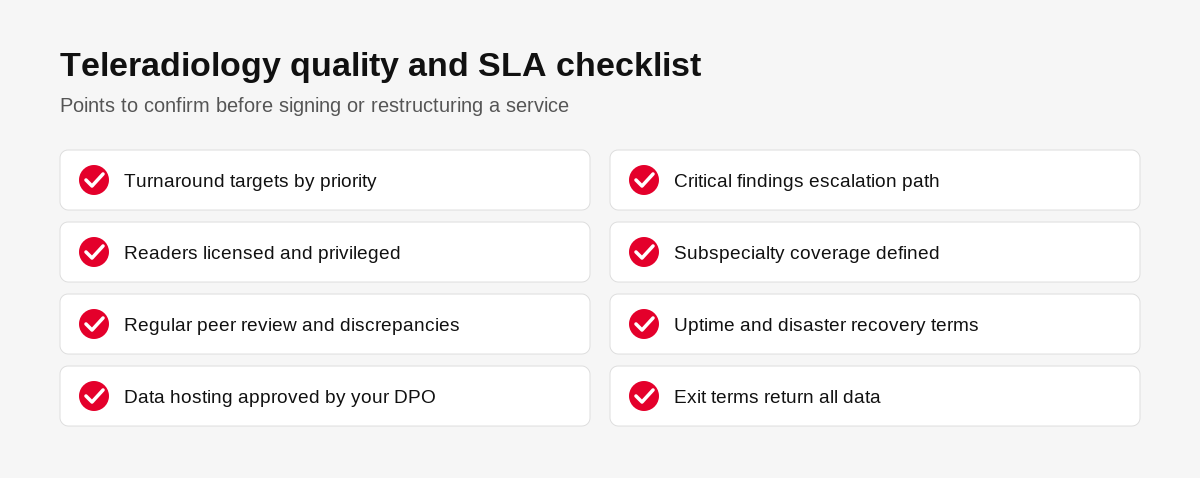
Before you sign a teleradiology agreement, or restructure an in-house service, make sure you can answer yes to each of these points.
- Turnaround targets are defined separately for stroke, trauma, emergency, inpatient and routine studies.
- Critical and unexpected findings have a documented escalation and communication process.
- Every reporting radiologist is licensed, credentialed and privileged for your patients.
- Subspecialty coverage is defined by modality and body region.
- A peer review and discrepancy process runs regularly, with shared results.
- Uptime, downtime procedures and disaster recovery are written into the contract.
- Data hosting, transfer basis and access controls are approved by your data protection officer.
- Monthly reporting covers volumes, turnaround, discrepancies and incidents.
- Exit terms cover the return of all reports and data.
Conclusion
Teleradiology can extend expert reporting to every site, round the clock, but its success depends as much on governance as on technology. Choose the operating model that fits your volumes and subspecialty needs, design it around local licensing and data protection rules, and manage it with clear service levels and transparent quality data.
Planning a teleradiology or remote reporting project? Talk to our team at info@teczodus.com.
Sources
- Saudi Ministry of Health: Legal Regulations for Telehealth Services
- Saudi Commission for Health Specialties: Professional classification from inside and outside the Kingdom
- Morgan Lewis: Saudi Arabia Personal Data Protection Law – Transition Period Ends September 14
- UAE Ministry of Justice: Federal Law No. 2 of 2019 on the Use of ICT in Health Fields
- Al Tamimi & Co: Regulated exemptions to restrictions on the transfer of health data outside the UAE
- Arab News: Saudi Arabia launches first virtual hospital
Talk to an expert
More insights
- India's ABDM Explained for Hospitals and Imaging Centres
ABHA, HPR, HFR, consent-based exchange, FHIR and incentives: what India's Ayushman Bharat Digital Mission means for hospitals, labs and imaging centres. - Going Digital in Pathology: What Labs Need First
Before buying scanners or AI, labs need the right foundations: storage, network, LIS integration, DICOM and validation. Here is what comes first. - Healthcare Data Migration: How to Move Without Losing Records
A vendor-neutral guide to migrating EMR and imaging data: planning, mapping, patient and study reconciliation, validation, cut-over and legacy archiving.