NPHIES Integration: What Hospital IT Teams Need to Know
For hospitals and clinics in Saudi Arabia that treat insured patients, NPHIES is the channel through which eligibility checks, authorisations and claims now flow. Connection is a regulatory expectation, but a good integration also protects revenue: every transaction that fails validation or is rejected by a payer delays cash and creates rework. This guide sets out what NPHIES is, how the technical integration works and how to prepare your IT team.
What NPHIES is and who runs it
NPHIES is Saudi Arabia's national platform for health information exchange. The Council of Health Insurance (CHI) announced that the platform was launched by CHI and the National Health Information Center in cooperation with the Ministry of Health, with first-wave entities required to comply from September 2021. Reporting on the programme describes two sides: the insurance side, managed by CHI, and a unified health record side overseen by the Ministry of Health.
On the insurance side, NPHIES sits between providers and insurers or third-party administrators (TPAs). Instead of separate portals and point-to-point links for each payer, a provider connects once, and the platform routes requests and responses. This also gives the regulator visibility of transactions across the market.
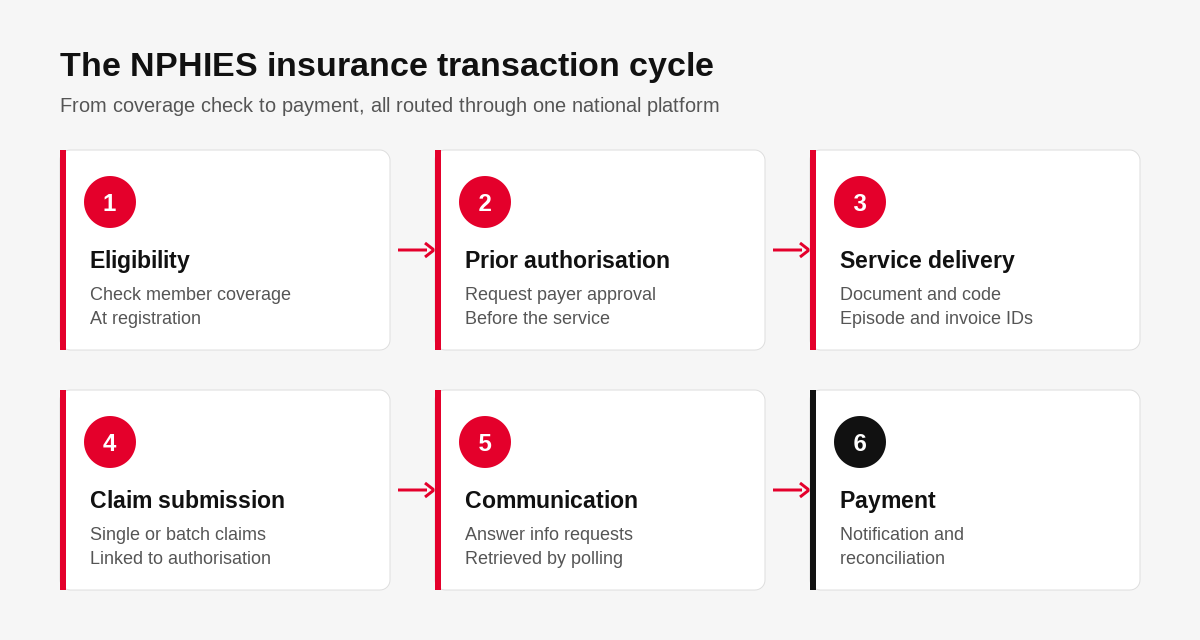
According to the published Healthcare Financial Services implementation guide, the core use cases are:
- Eligibility: eligibility checking for a patient's coverage.
- Authorisations: prior authorisation and advanced authorisation.
- Claims: individual claim submission and batch claims.
- Payment: payment notification and payment reconciliation.
- Communication: information requests from payers and information submissions from providers.
- Supporting: cancellation, error notice, polling and status check.
How the technical integration works
NPHIES is built on HL7 FHIR. The implementation guide, published by HL7 Saudi Arabia, is based on FHIR 4.0.1 (R4) and uses the FHIR messaging paradigm rather than simple REST calls. Key points for architects:
- Each transaction is a FHIR Bundle of type message, with a MessageHeader as the first entry identifying the event, for example a claim request.
- The bundle carries the business resource (such as Claim, CoverageEligibilityRequest or an authorisation request) together with supporting resources: Patient, Coverage, provider and insurer Organizations, Practitioner and Encounter.
- Claims use specific profiles (institutional, professional, pharmacy, oral and vision), each with its own required elements and extensions.
- If NPHIES cannot deliver a request to the insurer or TPA within one minute, it returns a pended or queued response. Deferred adjudications, unsolicited information requests and payment reconciliations are retrieved through polling, so your system must poll reliably and process what comes back.
- Request-level errors are returned as an OperationOutcome rather than a business response, and responses generated by NPHIES itself are tagged as such.
- Claims cannot be amended. To change a claim, you cancel it and submit a new one; resubmissions reference the original claim.
In practice, most hospitals do not build this from scratch. Their hospital information system (HIS) or revenue cycle platform provides the NPHIES connector, or a dedicated integration layer translates internal data into compliant bundles. Either way, your team owns data quality and process.
Onboarding and activation
CHI describes activation as the final stage before going live: a set of procedures and tests confirming the connection works, after which participants (providers, insurers, TPAs and system suppliers) obtain a certificate of integration. CHI encourages participants to integrate all insurance services, not just one. NPHIES also runs an academy with onboarding courses for system vendors and users. Before you start, confirm with your HIS supplier which use cases and IG version their connector is certified for, and plan time for end-to-end testing with your main payers.
Common reasons transactions fail or are rejected
Rejections come from two layers: technical validation by the platform and business adjudication by the payer. In general terms, the most frequent causes are:
- Structural or profile errors: missing mandatory elements, wrong profile or invalid extensions, rejected before reaching the payer.
- Coding problems: services, diagnoses or medications not mapped to the required code systems.
- Eligibility and coverage mismatches: incorrect member identifiers, expired policies or wrong payer selected.
- Missing or mismatched authorisation: a service requiring prior authorisation billed without a valid reference, or billed outside what was approved.
- Incomplete clinical justification: insufficient supporting information for medical necessity.
- Duplicates and identifier errors: reused invoice numbers or inconsistent episode identifiers.
- Unanswered information requests: payer requests missed because polling or work queues are not monitored.
NPHIES readiness checklist
Use this checklist before go-live and as a periodic health check:
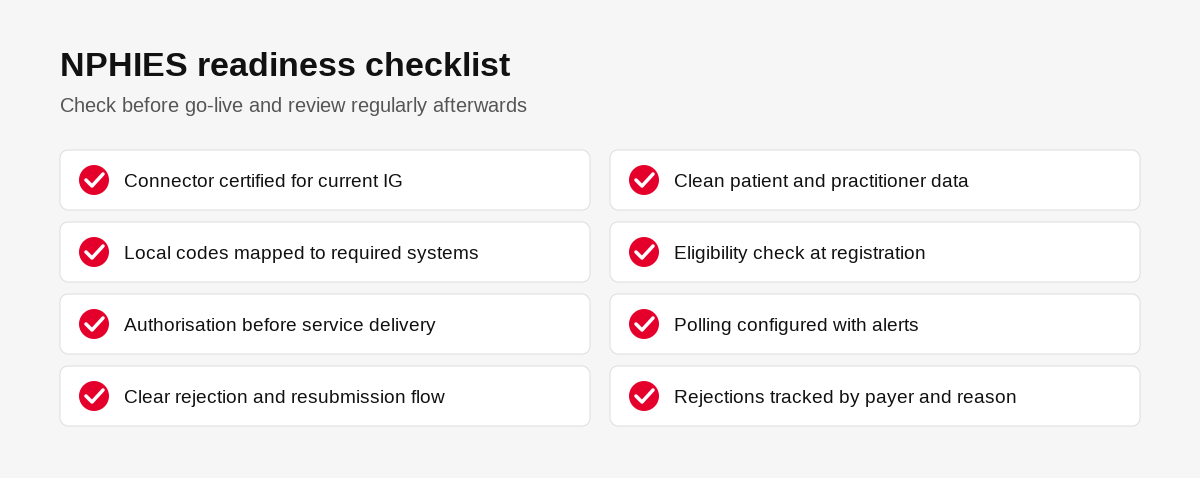
- Confirm your HIS or connector supports every use case you need, against the current IG version.
- Clean master data: patient identifiers, practitioner licences, facility and payer details.
- Map local service, diagnosis and drug codes to the required code systems, and assign ownership of updates.
- Embed eligibility checks at registration and authorisation checks before service delivery.
- Configure reliable polling with alerts for queued and unprocessed messages.
- Define a rejection workflow: who reviews, corrects, cancels and resubmits, and within what timeframe.
- Train front-desk, coding and claims staff, not only IT.
- Monitor rejection rates by payer and reason, and feed findings back into data and process fixes.
Conclusion
NPHIES integration is often treated as a one-off IT project, but in reality it is an ongoing revenue cycle capability. The FHIR messaging layer is well documented; the harder work lies in master data, coding, authorisation discipline and monitoring. Hospitals that invest in these foundations see fewer rejections, faster payments and a smoother path as the national platform expands.
Planning an NPHIES integration or revenue cycle improvement project? Talk to our team at info@teczodus.com.
Sources
- Council of Health Insurance: nphies Activation
- HL7 Saudi Arabia: NPHIES Healthcare Financial Services IG, Introduction
- HL7 Saudi Arabia: NPHIES IG, Use Cases
- HL7 Saudi Arabia: NPHIES IG, Claim Submission
- HL7 Saudi Arabia: NPHIES IG, Prior Authorization
- Healthcare IT News: Understanding NPHIES, KSA's health information exchange
- HL7 International: FHIR Summary
Talk to an expert
More insights
- India's ABDM Explained for Hospitals and Imaging Centres
ABHA, HPR, HFR, consent-based exchange, FHIR and incentives: what India's Ayushman Bharat Digital Mission means for hospitals, labs and imaging centres. - Going Digital in Pathology: What Labs Need First
Before buying scanners or AI, labs need the right foundations: storage, network, LIS integration, DICOM and validation. Here is what comes first. - Healthcare Data Migration: How to Move Without Losing Records
A vendor-neutral guide to migrating EMR and imaging data: planning, mapping, patient and study reconciliation, validation, cut-over and legacy archiving.