Planning a RIS/PACS Tender: A Requirements Checklist
A RIS/PACS replacement is one of the longest-lived technology decisions a hospital or imaging centre makes. The system chosen will shape radiologist productivity, referrer satisfaction and integration options for the better part of a decade. Yet many tenders in the GCC and India are still built from recycled specifications, generic feature lists and a heavy weighting on price, which makes it hard to tell strong bids from weak ones.
This guide sets out how to build a requirements specification that reflects how your organisation actually works, how to evaluate and score responses fairly, and the mistakes that most often lead to regret after go-live.
Start with workflow, not features
The strongest tenders begin with a clear description of current and future clinical workflow rather than a list of features. Map the journey of a typical examination from order to report: how orders arrive, how patients are scheduled and registered, how worklists reach modalities, how studies are read and reported, how critical results are communicated and how reports reach referrers.
Then capture the requirements that matter clinically:
- Ordering and scheduling. Electronic orders from the EMR, multi-modality scheduling, resource and room booking, and patient preparation instructions.
- Reading and reporting. Configurable worklists across sites, hanging protocols, structured reporting templates, speech recognition in the languages your radiologists use, and peer review.
- Results communication. Critical result alerts with acknowledgement, report distribution and referrer image access.
- Teleradiology and multi-site reading. Remote reading performance, load balancing and subspecialty routing.
- Bilingual needs. Arabic and English patient-facing documents in the GCC, or regional language support where relevant in India.
Write each requirement as an outcome that can be demonstrated, for example "a radiologist can open a CT study with three priors within an agreed time over the hospital WAN", rather than "fast viewer".
Integration and standards requirements
Integration failures are the most common source of delays and cost overruns. Specify the standards and profiles you expect, and ask bidders to state compliance precisely:
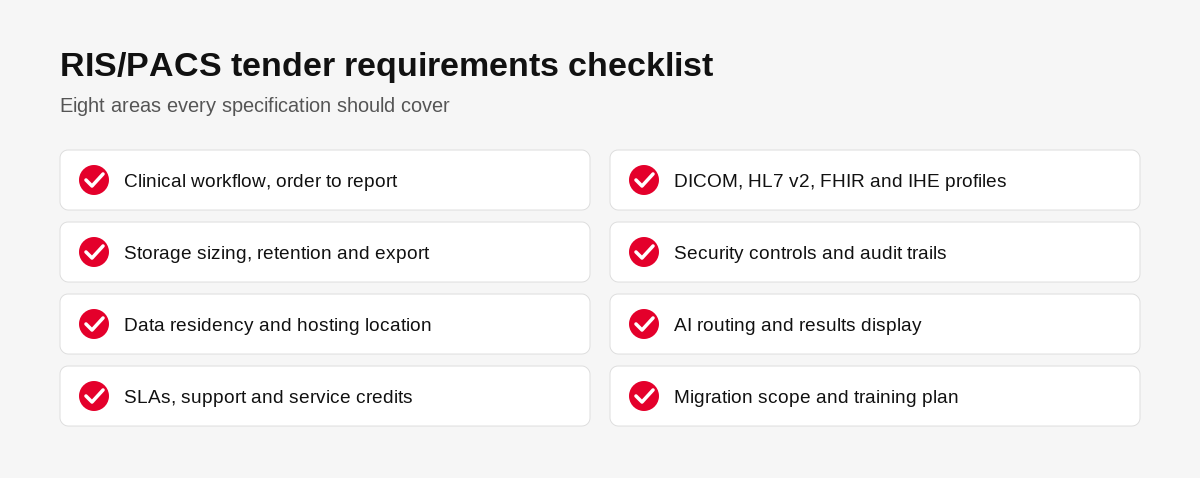
- DICOM services for storage, query/retrieve, modality worklist and modality performed procedure step, plus DICOMweb for web-based access. Request DICOM conformance statements.
- HL7 v2 messages for orders, results, patient administration and merges, mapped to your EMR's actual interfaces.
- HL7 FHIR for newer integrations. Ask which resources are supported, such as ImagingStudy and, for vendors on FHIR R5, ImagingSelection for key images and regions of interest.
- IHE profiles from the IHE Radiology domain, such as Scheduled Workflow, Patient Information Reconciliation and XDS-I.b for image sharing.
- National platforms. Any required connections to national health information exchanges, insurance or referral platforms.
Ask for a list of live sites where each interface is already running, not just a statement that it is supported.
Storage, security and data residency
Specify expected study volumes, growth assumptions and retention periods, then ask bidders to size online, near-line and disaster recovery storage against them. Require that all images and reports can be exported in standard, non-proprietary formats with complete metadata at the end of the contract.
Security requirements should cover role-based access, audit trails, encryption in transit and at rest, multi-factor authentication for remote access, vulnerability management and patching commitments. Data residency deserves its own section. Saudi Arabia's Personal Data Protection Law restricts transfers of personal data outside the Kingdom to specified purposes and conditions, and India's Digital Personal Data Protection Rules, 2025 introduce phased obligations for data fiduciaries over eighteen months. For cloud or hybrid offers, require bidders to state where data, backups and support access are located.
AI readiness, SLAs, migration and training
AI readiness. Even if you have no AI tools today, you will likely add some during the contract. Ask how the platform routes studies to AI applications and displays their results. IHE has published profiles for this, including AI Workflow for Imaging (AIW-I) and AI Results (AIR), which standardises how findings, measurements and segmentations are stored and shown alongside images.
Service levels. Define uptime targets, response and resolution times by severity, local or in-region support availability, planned maintenance windows and service credits. Clarify who supports third-party components such as servers, storage and speech recognition.
Migration. Require a migration methodology covering legacy image and report volumes, data cleansing, identifier reconciliation, validation and parallel running. Make the bidder responsible for a defined migration scope with acceptance criteria.
Training. Ask for role-based training plans for radiologists, technologists, front desk and IT, with super-user programmes and refresher sessions after go-live.
Evaluation and scoring
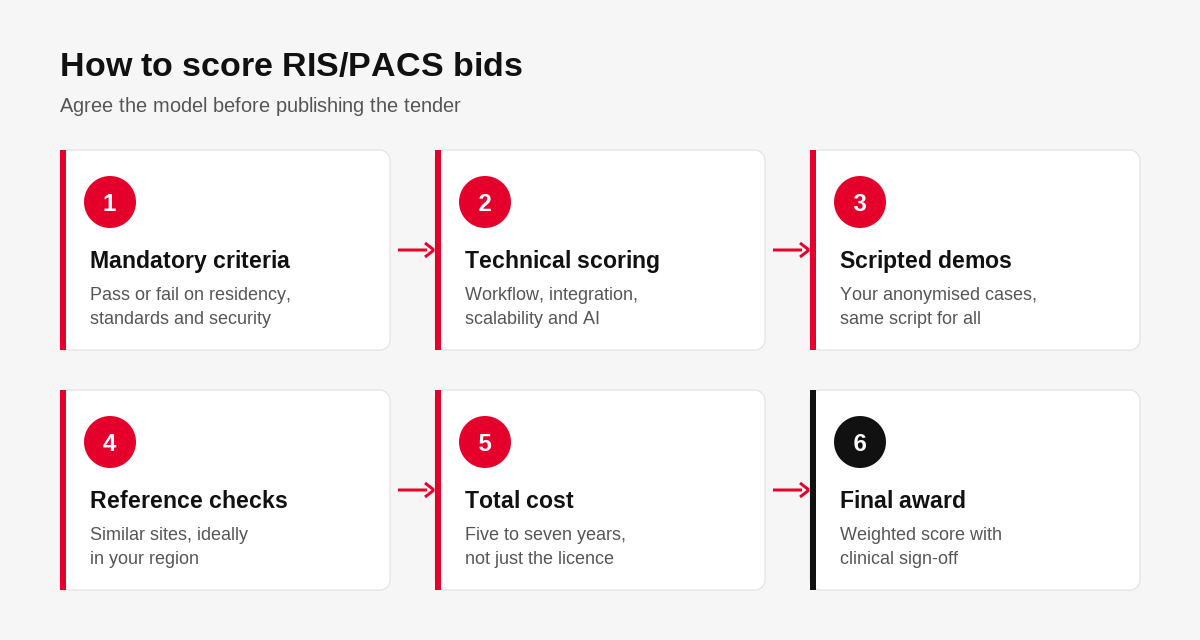
Decide the scoring model before the tender is published and share the weighting with bidders. A balanced model usually separates technical and commercial evaluation and gives clinical stakeholders a real voice:
- Mandatory criteria scored pass or fail, such as data residency, core DICOM and HL7 compliance and minimum security controls.
- Weighted technical criteria for workflow fit, integration, scalability, AI readiness and support.
- Scripted demonstrations using your own anonymised cases and workflows, scored by radiologists and technologists against the same script for every bidder.
- Reference checks with sites of similar size and complexity, ideally in your region.
- Total cost of ownership over at least five to seven years, including hardware, storage growth, interfaces, migration, upgrades and support, not just the initial licence.
Common mistakes to avoid
- Copying another hospital's specification without adapting it to your workflow and volumes.
- Writing requirements as features rather than measurable, demonstrable outcomes.
- Letting price dominate scoring, so that the cheapest compliant bid wins regardless of fit.
- Omitting data export and exit terms, which locks your images into one supplier.
- Underestimating migration and interface work, then discovering the costs as change requests.
- Excluding radiologists and technologists from demonstrations and scoring.
- Leaving AI, cloud and national platform integration out of scope because they are not needed on day one.
Conclusion
A good RIS/PACS tender is less about the length of the specification and more about its clarity. Describe your workflow, specify standards precisely, insist on data portability and residency compliance, plan for AI and migration, and score bids against weightings agreed in advance. That discipline gives every bidder a fair chance and gives your organisation a system it can rely on for years.
Planning a RIS/PACS tender or replacement project? Talk to our team at info@teczodus.com.
Sources
- IHE International: Radiology (RAD) domain profiles
- IHE International: AI Workflow for Imaging (AIW-I) supplement
- IHE International: AI Results (AIR) profile
- HL7 International: FHIR ImagingSelection resource
- Al Tamimi & Company: An overview of Saudi Arabia's amended Personal Data Protection Law
- Press Information Bureau, Government of India: DPDP Rules, 2025 backgrounder
Talk to an expert
More insights
- India's ABDM Explained for Hospitals and Imaging Centres
ABHA, HPR, HFR, consent-based exchange, FHIR and incentives: what India's Ayushman Bharat Digital Mission means for hospitals, labs and imaging centres. - Going Digital in Pathology: What Labs Need First
Before buying scanners or AI, labs need the right foundations: storage, network, LIS integration, DICOM and validation. Here is what comes first. - Healthcare Data Migration: How to Move Without Losing Records
A vendor-neutral guide to migrating EMR and imaging data: planning, mapping, patient and study reconciliation, validation, cut-over and legacy archiving.