Selling Healthcare Software in Saudi Arabia: A Vendor Guide
Saudi Arabia is one of the most attractive healthcare IT markets in the world right now. The Health Sector Transformation Programme under Vision 2030 is reshaping how care is organised, funded and digitised, and both public and private providers are investing in modern clinical systems. Yet many international vendors find that a strong product and a good demo are not enough. Registration, procurement rules, data requirements and the choice of local partner decide who wins.
This guide is written for healthcare software and AI vendors planning to enter the Kingdom. It covers who buys, what regulators expect, how tenders work, and how to choose the right entry model.
Understand who actually buys
The Saudi healthcare system is changing shape. Public hospitals are moving from direct Ministry of Health management into regional health clusters under the Health Holding Company. The Ministry reports that more than 130,000 employees have already transferred to 10 health clusters across two phases. For vendors, this means decision-making is moving closer to the clusters, and relationships built only at ministry level may no longer be enough.
Beyond the clusters, the market includes several distinct buyer groups:
- Health clusters: public hospitals and primary care, increasingly buying through cluster-level teams.
- NUPCO: the National Unified Procurement Company, owned by the Public Investment Fund, which runs unified procurement for government health providers.
- Military, National Guard and university hospitals: large, sophisticated organisations with their own procurement processes.
- Specialist and referral hospitals: often early adopters of advanced imaging, AI and enterprise platforms.
- Private providers: hospital groups and imaging centres that can move faster and buy on value.
- Insurers and payers: anything touching claims has to work with NPHIES, the national health insurance exchange platform.
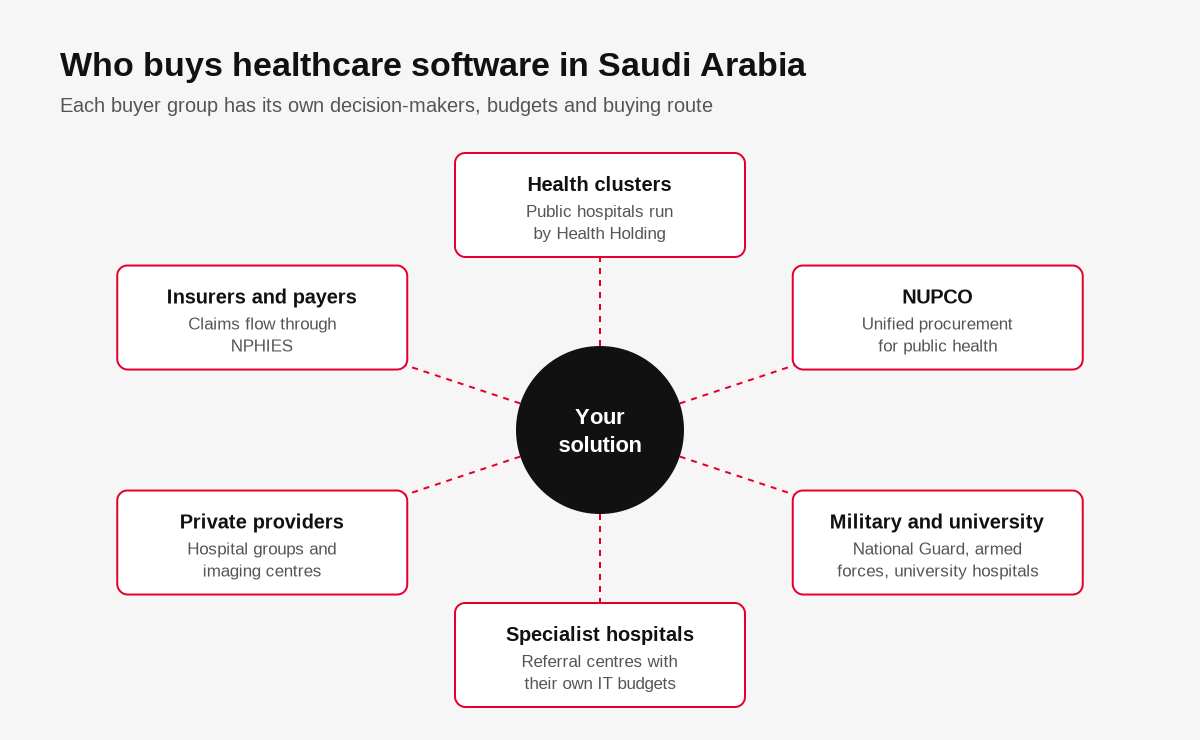
Each group has different budgets, timelines and evaluation criteria. A clear target list, rather than "the Saudi market", saves months.
Check whether your software is a medical device
If your product informs diagnosis or treatment, the Saudi Food and Drug Authority (SFDA) is likely to treat it as Software as a Medical Device (SaMD). The SFDA has published dedicated guidance on SaMD and follows the IMDRF risk-based approach, which places software into categories according to how serious the clinical situation is and how much the output drives decisions. Radiology AI, pathology AI and clinical decision support tools usually fall into this scope. PACS viewers used for diagnosis may too.
In practice, regulatory specialists describe a few consistent requirements:
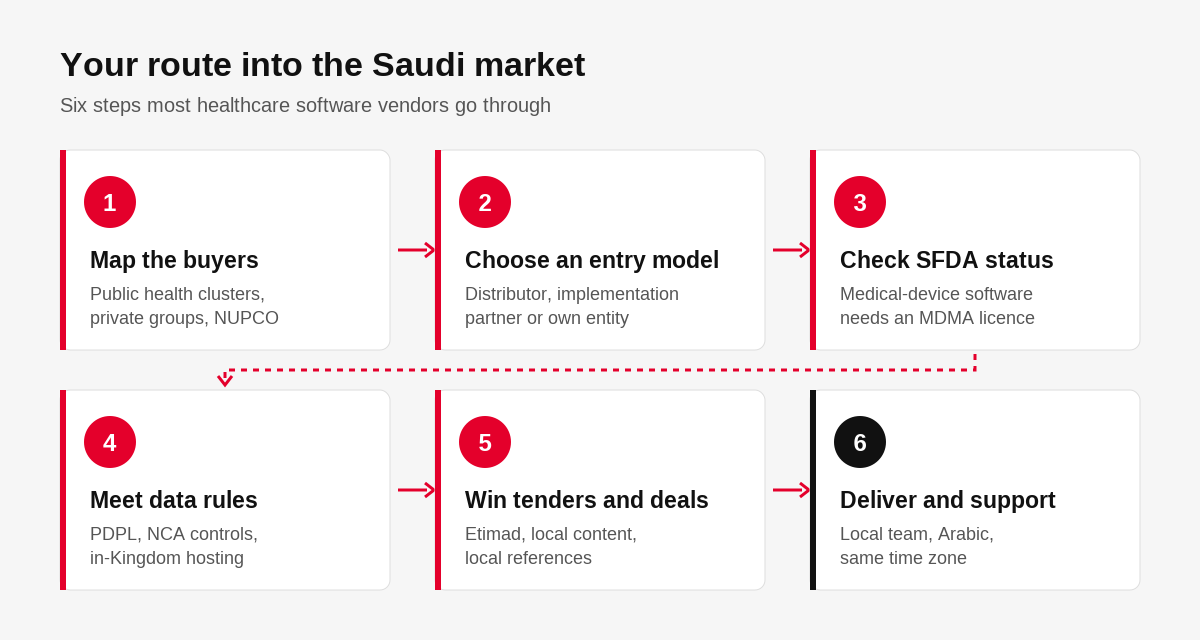
- Medical Device Marketing Authorisation (MDMA) before the product can be marketed.
- A Saudi Authorised Representative for manufacturers without a local entity.
- Prior approval in a reference market such as the EU, the US, Canada, Japan or Australia, which is generally expected before an MDMA application.
- Realistic timelines: the official review period is short, but end-to-end approval often takes several months.
Start this early. A missing licence is one of the most common reasons a strong bid is disqualified.
Plan for data protection and hosting
Healthcare data is among the most sensitive data a vendor can handle, and Saudi rules reflect that. The Personal Data Protection Law (PDPL), overseen by SDAIA, applies higher standards to health data and restricts transfers outside the Kingdom. The National Cybersecurity Authority (NCA) sets cybersecurity controls, including specific controls for cloud services, that flow down to suppliers of government and critical-sector organisations.
For government-linked customers, the general expectation is that data stays inside Saudi Arabia. Before you bid, be ready to answer:
- Can the solution run on-premise or in an in-Kingdom cloud region?
- Which cloud provider and hosting region will you use, and is it registered locally?
- How do remote support and vendor access work without moving patient data abroad?
- Which NCA controls does your solution and support model meet?
Navigate tenders, local content and the RHQ rule
Public-sector deals usually run through formal tenders, published on the government's Etimad platform or through NUPCO. Three rules shape how international vendors compete:
- Local content preference: under the Government Tenders and Procurement Law, the Local Content and Government Procurement Authority (LCGPA) applies a price preference to national products. Law firm Clyde & Co explains that, for products not on the mandatory list, foreign bids can be evaluated as if they were 10% more expensive.
- The Regional Headquarters (RHQ) rule: since 1 January 2024, government entities have been restricted from contracting directly with multinational companies that do not have their regional headquarters in the Kingdom.
- Supplier registration: NUPCO and government buyers expect local commercial registration and, for medical devices, valid SFDA approval.
For many vendors, the practical answer is to compete through a qualified Saudi partner rather than bidding directly, at least in the first phase.
Choose the right entry model
There is no single correct structure. Most vendors choose one of three models, and many move between them as the business grows.
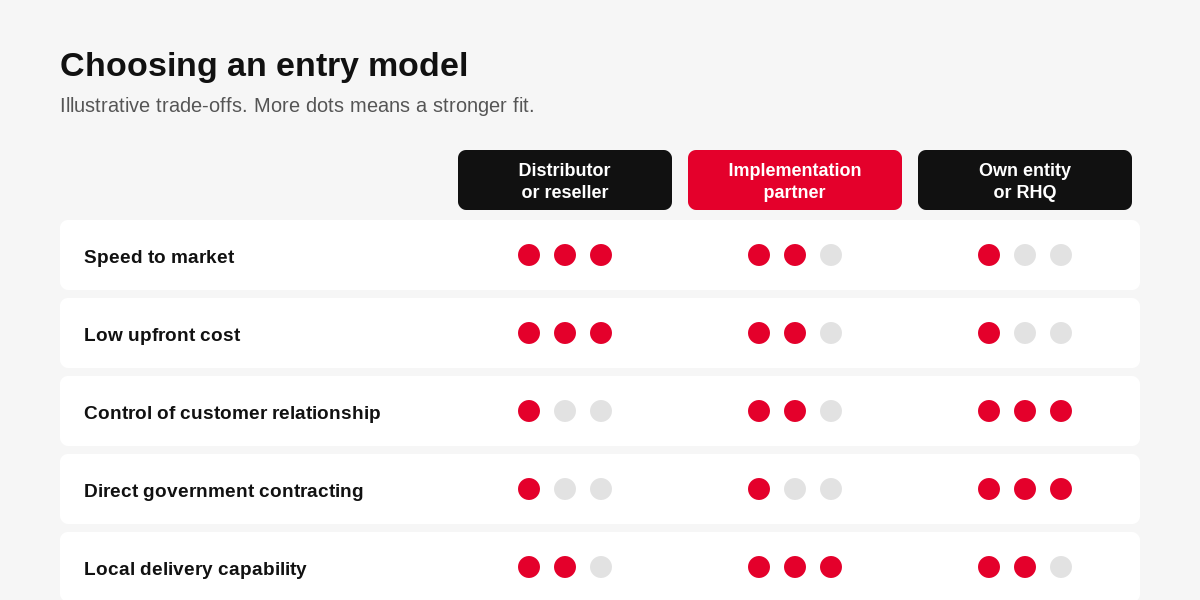
- Distributor or reseller: the fastest and lowest-cost route, but you have less control over pricing, positioning and the customer relationship.
- Implementation partner: a local partner that sells, implements, integrates and supports your product. This balances speed with delivery quality, and suits complex systems such as PACS, RIS, EMR and AI that need HL7, DICOM and FHIR integration.
- Own entity or RHQ: the most control and direct access to government contracts, but also the highest cost, with licensing, hiring and Saudisation commitments.
A common path is to start with an implementation partner, win reference sites, and then decide whether a local entity is justified by the pipeline.
A practical checklist before you enter
- Define your first two or three target buyer groups and named accounts.
- Confirm your SFDA classification and start the MDMA process if needed.
- Prepare an in-Kingdom hosting option and a clear data-protection position.
- Arabise the user interface, documents and training materials where users need them.
- Shortlist local partners based on delivery capability, not just sales contacts.
- Agree clear roles for pre-sales, implementation, first-line support and escalation.
- Budget for at least one funded pilot or reference site.
- Plan a 12 to 24 month horizon. Public-sector cycles in particular take time.
Conclusion
Saudi Arabia rewards vendors who come prepared: the right registrations, a credible hosting answer, and a local partner who can deliver and support as well as sell. Getting these foundations right early is far cheaper than fixing them after a failed tender.
Planning to enter the Saudi healthcare market? Talk to our team at info@teczodus.com.
Sources
- Saudi Ministry of Health: Health Holding completes staff transfer to health clusters
- Vision 2030: Health Sector Transformation Program
- OMC Medical: How Saudi Arabia regulates Software as a Medical Device
- MedEnvoy: Saudi Arabia medical device registration requirements
- Mayer Brown: Updates on Saudi Arabia's Regional Headquarters Program
- Clyde & Co: Local content in Saudi public procurement
- Morgan Lewis: Saudi Arabia cloud compliance and data residency
- Bird & Bird: Health data under the Personal Data Protection Law
Talk to an expert
More insights
- India's ABDM Explained for Hospitals and Imaging Centres
ABHA, HPR, HFR, consent-based exchange, FHIR and incentives: what India's Ayushman Bharat Digital Mission means for hospitals, labs and imaging centres. - Going Digital in Pathology: What Labs Need First
Before buying scanners or AI, labs need the right foundations: storage, network, LIS integration, DICOM and validation. Here is what comes first. - Healthcare Data Migration: How to Move Without Losing Records
A vendor-neutral guide to migrating EMR and imaging data: planning, mapping, patient and study reconciliation, validation, cut-over and legacy archiving.