VNA vs PACS: Does Your Hospital Need a Vendor-Neutral Archive?
Few imaging decisions generate as much debate in hospital IT steering committees as the vendor-neutral archive. Some organisations treat a VNA as an essential foundation for enterprise imaging; others find that a well-run PACS already does everything they need. For CIOs and imaging leaders in the GCC and India, where hospital groups are expanding quickly and data protection rules are tightening, the right answer depends on your estate, your growth plans and your appetite for complexity.
This guide explains what a VNA actually is, where it earns its keep, what it really costs, and how to decide whether your organisation needs one now, later or not at all.
What a VNA is, and what it is not
A Picture Archiving and Communication System (PACS) is primarily a clinical tool. It receives images from modalities, manages worklists with the RIS, presents studies to radiologists through a diagnostic viewer and stores the results. In most PACS, the archive is tightly coupled to the application: images are stored in formats, folder structures and databases that the PACS vendor controls.
A vendor-neutral archive separates storage from the application. It is a standards-based repository that stores imaging objects in open formats, exposes them through standard interfaces such as DICOM, DICOMweb and IHE profiles, and can serve several PACS, viewers and departments at once. The key idea is that the clinical application can change without moving or converting the archive.
It is worth noting that the HIMSS-SIIM collaborative white paper on enterprise imaging deliberately uses the term enterprise image repository rather than VNA, observing that a central repository "may or may not be implemented (or branded)" as a VNA and that a product sold as a VNA may include features an enterprise does not need. In other words, the label matters less than the capabilities.
A VNA is not a replacement for diagnostic reading. Radiologists still need a PACS or diagnostic viewer, and departments still need workflow tools. The VNA sits underneath them.
When a VNA adds real value
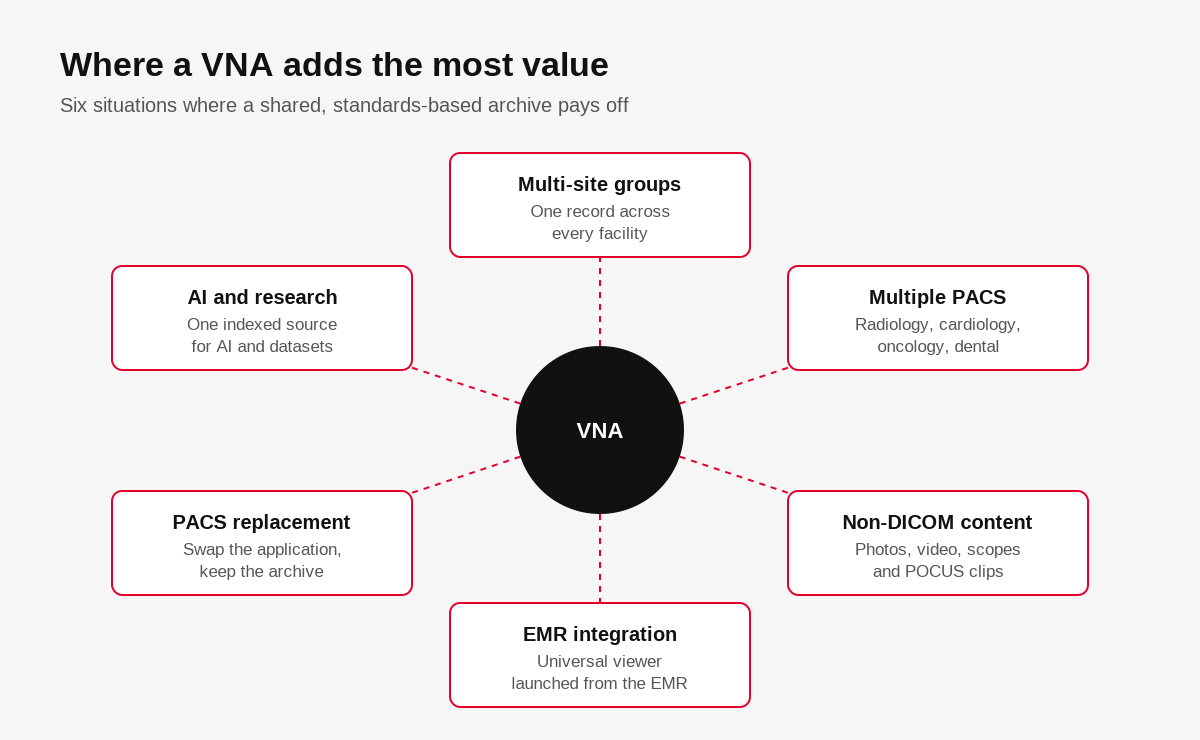
A VNA tends to justify itself in a small number of recognisable situations:
- Multi-site groups. When a hospital group operates several facilities, each with its own PACS, a shared archive gives clinicians one longitudinal patient record across sites instead of fragmented silos.
- Multiple departmental PACS. Radiology, cardiology, oncology and dentistry often run separate systems. Consolidating their archives reduces duplicated storage and simplifies retention management.
- Non-DICOM content. Dermatology photographs, endoscopy and surgical video, wound images and point-of-care ultrasound clips often live on local drives or devices. The HIMSS-SIIM paper notes that formats such as JPEG, MPEG and TIFF can be imported and, where supported, wrapped in DICOM, provided metadata is captured at the point of the encounter.
- Enterprise imaging and EMR integration. A single repository makes it easier to launch a universal viewer from the EMR and to share images regionally using standards such as IHE XDS-I.b, which publishes manifests that point to the stored images rather than copying them centrally.
- Planned PACS replacement. If the current PACS contract ends in the next few years, an independent archive can turn future PACS migrations from a multi-year data conversion into a much simpler application swap.
- AI and research. A consolidated, well-indexed archive is easier to feed to AI tools and to de-identify for research datasets than a dozen departmental stores.
When a well-run PACS is enough
For a single-site hospital or imaging centre with one PACS, mostly radiology content and no near-term replacement planned, a VNA often adds cost and another integration layer without a matching benefit. Many modern PACS platforms already offer DICOMweb interfaces, multi-department support and long-term archive tiers.
In these cases the smarter investment is usually to make sure the existing PACS contract guarantees data export in standard DICOM, with complete metadata and without punitive exit fees. That protects your future options at a fraction of the cost.
Costs and complexity to plan for
The licence is rarely the largest cost. Hospitals that underestimate a VNA usually underestimate the following:
- Data migration. Moving historical studies out of legacy archives is slow and often reveals inconsistent patient identifiers, proprietary compression and missing metadata that need clean-up.
- Integration effort. Each PACS, modality, EMR and viewer needs interfaces configured, tested and maintained, including synchronisation of deletions, merges and corrections.
- Patient identity. Multi-site groups need a reliable master patient index or identifier cross-referencing strategy. Without it, a shared archive simply centralises the mismatches.
- Storage and retention. Duplicate copies held during transition, disaster recovery replicas and long retention periods all drive storage growth.
- Governance and skills. Someone must own lifecycle policies, access controls and quality checks. Many organisations need new informatics roles to run enterprise imaging well.
- Data residency. Where the archive sits matters. Saudi Arabia's Personal Data Protection Law, supervised by SDAIA, places conditions on transferring personal data outside the Kingdom, while India's Digital Personal Data Protection Rules were notified in November 2025 with an eighteen-month phased compliance window. Cloud-hosted VNA options must be assessed against these requirements and any health-sector rules.
A practical decision checklist
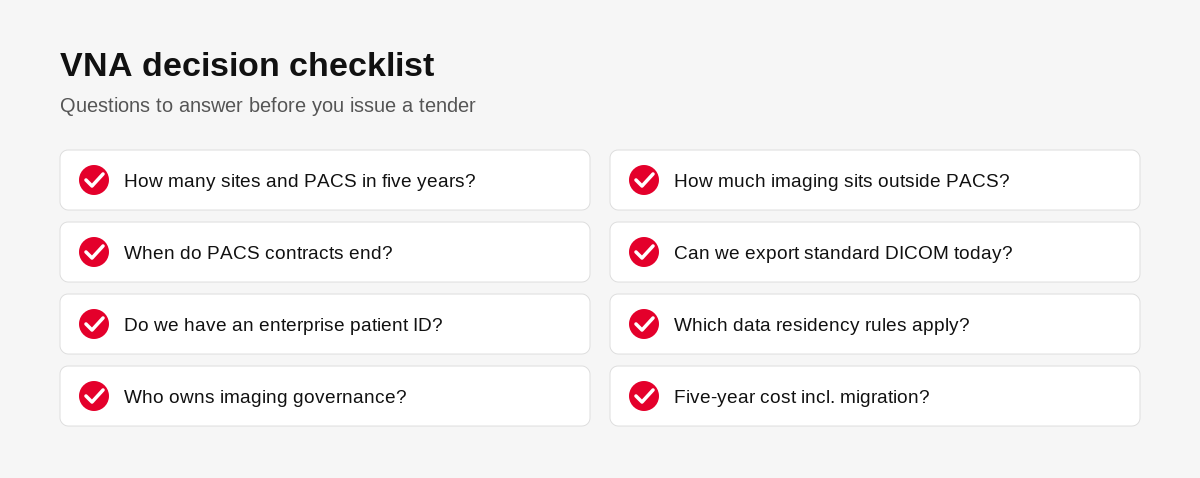
Before issuing a tender or signing a quotation, work through these questions with clinical, IT and finance stakeholders:
- How many PACS, departmental systems and imaging sites do we run today, and how many will we run in five years?
- How much clinically relevant imaging sits outside PACS, on devices, shared drives or USB media?
- When do our current PACS contracts end, and can we export our data in standard DICOM today?
- Do clinicians need one longitudinal view of a patient's imaging across sites?
- Do we have a dependable enterprise patient identifier, or a realistic plan to build one?
- Which national or regional data residency rules apply, and does the hosting model comply?
- Who will own enterprise imaging governance once the project team disbands?
- Have we costed migration, integration and storage growth over at least five years, not just the licence?
If most answers point to multiple sites, multiple systems and significant non-DICOM content, a VNA or enterprise image repository is likely to pay off. If most point to a single site with one stable PACS, focus first on contractual data portability and standards-based interfaces.
A phased approach works best
Organisations that succeed with enterprise imaging rarely do everything at once. A sensible sequence is to establish patient identity and governance first, consolidate the largest DICOM archives next, then onboard non-DICOM departments one by one, and finally connect the EMR, regional sharing and AI workflows. Each phase should have clear clinical owners and measurable outcomes, such as reduced repeat imaging or faster access to prior studies.
Conclusion
A VNA is not a status symbol and not a default upgrade from PACS. It is an architectural choice that pays off when imaging is spread across sites, systems and departments, and when the organisation intends to change clinical applications over time. For smaller or single-site providers, strong exit clauses and standards-based interfaces may deliver most of the benefit at far lower cost. The right decision starts with an honest inventory of your imaging estate and a five-year view of where your organisation is heading.
Planning a VNA or enterprise imaging project? Talk to our team at info@teczodus.com.
Sources
- Journal of Digital Imaging: Technical Challenges of Enterprise Imaging, HIMSS-SIIM Collaborative White Paper
- IHE International: Cross-enterprise Document Sharing for Imaging (XDS-I.b)
- Al Tamimi & Company: An overview of Saudi Arabia's amended Personal Data Protection Law
- Bird & Bird: Saudi Arabia, health data under the Personal Data Protection Law
- Press Information Bureau, Government of India: DPDP Rules, 2025 backgrounder
Talk to an expert
More insights
- India's ABDM Explained for Hospitals and Imaging Centres
ABHA, HPR, HFR, consent-based exchange, FHIR and incentives: what India's Ayushman Bharat Digital Mission means for hospitals, labs and imaging centres. - Going Digital in Pathology: What Labs Need First
Before buying scanners or AI, labs need the right foundations: storage, network, LIS integration, DICOM and validation. Here is what comes first. - Healthcare Data Migration: How to Move Without Losing Records
A vendor-neutral guide to migrating EMR and imaging data: planning, mapping, patient and study reconciliation, validation, cut-over and legacy archiving.